Imagine you’re on a cross-country trip in the United States, you need to move funds between a Monero wallet and a Bitcoin address while staying off the public Wi‑Fi tracking radar, and you want to do the swap quickly without sending coins to an exchange that requires KYC. You pull out your phone, open a privacy-centric mobile wallet, and expect the device to handle everything securely and privately. That intuitive picture is partly true — but it hides a tangle of mechanisms, trade-offs, and limits. This article walks through what a modern privacy-first mobile wallet does, what it cannot do for you, and how specific features change the privacy-security calculus for Monero, Bitcoin, and other coins.
Start with the core misconception I see most often: “Privacy wallet” is not a single feature you turn on. It is an architecture and a set of choices — network routing, key custody, node selection, coin rules, and optional layers like MWEB or shielding — that interact. Knowing those mechanisms is the fastest way to make sensible security decisions and to spot when a product’s marketing glosses over important boundary conditions.
How privacy is built: layers not miracles
Privacy-focused wallets combine several distinct mechanisms. First, network anonymity: routing your wallet traffic over Tor-only mode or I2P, or connecting to self-selected nodes, reduces IP address leakage. Second, data minimization: a zero-telemetry policy means the developers don’t collect your transaction history or device identifiers. Third, non-custodial architecture ensures private keys remain on-device, protected by device-level encryption (Secure Enclave on iOS, TPM on Android) and local authentication — PINs or biometrics. Fourth, coin-specific privacy tech (Monero subaddresses and view-key protections; Bitcoin coin control, PayJoin v2, Silent Payments; Litecoin MWEB) adds protocol-level defenses.
Those elements operate together but are not redundant. Network routing prevents an observer from linking your IP to a transaction broadcast. Key custody prevents the company from spending your funds. Coin-level tools reduce on-chain linkability. Removing any layer weakens privacy in different ways: a private key on-device with a clear IP address still links transactions to your network footprint; using Tor but exposing keys in an online backup compromises control. Understanding which layer protects which risk is essential.
In-wallet exchange: convenience, routing, and the privacy trade-offs
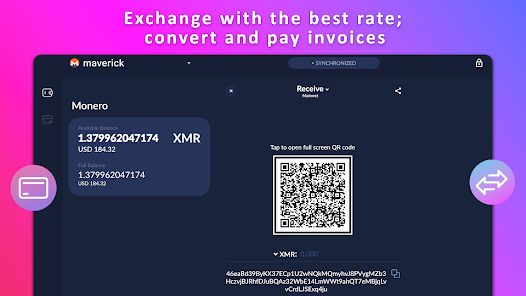
Built-in swapping in modern wallets can be a powerful convenience: you can swap BTC to XMR or ETH within the app without leaving your keys in a custodian. Decentralized routing systems such as NEAR Intents are used to automate finding competitive rates across multiple market makers without relying on a single centralized counterparty. This reduces counterparty risk and can preserve privacy compared with custodial exchanges that require KYC and hold funds.
But “in-wallet” does not automatically equal “private.” Swaps require liquidity and a routing path. Some paths involve on-chain transactions that reveal linking information unless the protocol adds obfuscation (e.g., Monero’s ring signatures). Decentralized order routing improves privacy relative to centralized incumbents, but it still surfaces interactions with market makers. The practical heuristic: prefer routing that minimizes custodial custody duration and uses privacy-preserving rails where available. If you need to swap a privacy coin into a transparent chain, expect additional linkability unless the wallet performs a privacy-preserving construction on-chain.
For users who prioritize privacy, a wallet that supports in-wallet swaps between dozens of assets without arbitrary limits is attractive — but verify how the swap is implemented. Does the trade route through a third-party custodian for settlement? Are transactions batched or chained? Cake Wallet’s in-app swapping uses decentralized routing and aims to avoid centralized custody, which reduces a major privacy risk, but you should still treat each swap as a potential metadata event: where did the counterparties accept funds, and what on-chain footprints remain?
Coin-by-coin realities and common myths
Myth 1: All privacy coins are equivalent. Reality: Each coin’s privacy model differs and so do its operational limits. Monero (XMR) is privacy-by-default at the protocol layer: ring signatures, stealth addresses, and confidential transactions obscure sender, recipient, and amount. Wallets that support Monero must maintain the private view key on-device and allow subaddresses to reduce address reuse; background synchronization helps keep a mobile wallet practical. The key limitation: Monero’s privacy relies on consensus-wide mixing properties — if network participation falls or ring sizes shrink, theoretical traceability risks increase. That is an active, technical debate among researchers and practitioners.
Myth 2: Using Tor is sufficient to anonymize transactions. Reality: Tor hides network-level identifiers but doesn’t protect you from mistakes like address reuse, linking via on-chain clustering, or revealing private view keys accidentally. Tor-only mode and I2P proxy support substantially reduce IP leakage, but operational security still matters: connecting from the same physical device to custodial services or reusing public addresses can re-link your activities.
Myth 3: Hardware wallets solve all risks. Reality: Hardware wallets significantly reduce key-exfiltration risks, and integrating Ledger or air-gapped devices like Cupcake with a software wallet raises the bar for attackers. However, physical theft, cold storage mismanagement, or malware on the host device (which can manipulate transaction outputs or amounts before signing) are still valid threats. The appropriate security posture is layered: device-level encryption, external hardware signing, and careful verification of transaction details.
Bitcoin privacy is distinct and incremental
Bitcoin lacks Monero’s built-in privacy. Wallet-level tools such as UTXO coin control, transaction batching, PayJoin v2 (which mixes inputs between payer and payee), and Silent Payments are designed to reduce linkability. They are not panaceas: many chain-analytic firms and exchanges can still infer linkages from patterns and timing. The user-level trade-off is often usability versus privacy: aggressive coin control or batching can increase complexity and sometimes cost (timing or fee-related), while simpler transactions are easier to manage but leak more metadata.
For U.S. users who need plausible on-chain privacy without violating laws, these tools are useful when combined with network-level anonymity and disciplined wallet hygiene (use subaddresses, avoid address reuse, consolidate UTXOs privately). Remember: stronger privacy measures sometimes reduce interoperability (some merchants and services may not accept complex transaction formats) and they won’t prevent a compelled disclosure of device contents or a carefully executed phishing attack.
Operational limits you must accept
No wallet can protect you against all privacy-compromising vectors. Device compromise (malware), coercion, backup leaks (seed phrase exposure), and poor OPSEC (posting addresses publicly) are common failure modes. There are coin-specific migration issues too: Zcash migration from some wallet types (for example, Zashi wallets) can be incompatible due to change-address handling; this requires manual transfers rather than seed migration — an important operational caveat for ZEC holders planning migrations.
Another practical limit: MWEB (Litecoin’s MimbleWimble Extension Blocks) and Zcash shielding offer optional privacy layers, but they rely on adoption and interoperable tooling. If a minority of users enable an opt-in privacy layer, the anonymity set can be small, lowering the effectiveness of the privacy mechanism. For Monero the anonymity set is generally larger because privacy is integrated by default, but technical debates about parameter settings and traceability techniques continue.
Decision framework: choosing features that matter to you
When selecting a mobile privacy wallet, use this quick decision heuristic: 1) Threat model first — are you protecting against casual chain analysis, an ISP-level observer, or targeted forensic analytics? 2) Layers second — require network anonymity (Tor/I2P), non-custodial key control, and device-level hardware protection. 3) Coin capabilities third — ensure the wallet supports the coins you need and their privacy tools (e.g., Monero subaddresses, Bitcoin PayJoin, Litecoin MWEB, Zcash mandatory shielding). 4) Swap transparency — prefer decentralized routing and short custody duration in any in-app swap. 5) Operational fit — check platform support (iOS, Android, desktop), hardware wallet compatibility, and the migration caveats that might affect you.
If you want to evaluate a specific app on your phone today, a useful checklist: confirm Tor-only mode works, verify the private view key never leaves the device for Monero, test a small PayJoin transaction with a friendly counterparty, and practice restoring a wallet from your seed on a test device to ensure your backup routine is robust. For an installation source and binary options across platforms, see the official download link for clarity: cake wallet download.
What to watch next — conditional scenarios
Privacy tech is evolving; watch these conditional developments rather than predictions. If adoption of optional privacy extensions (e.g., MWEB, ZEC shielding) grows, their anonymity sets will increase and on-chain privacy will materially improve for users who opt in. Conversely, regulatory pressure on in-app swap routing or market makers could push some liquidity into more centralized or KYC’d pathways, increasing metadata leakage risk for swaps. Finally, improvements in node-level analysis or timing correlation attacks could make network-layer defenses more important, reinforcing the utility of Tor/I2P and custom node selection.
FAQ
Does using Tor guarantee my transactions are anonymous?
No. Tor reduces IP-level correlation but does not change what is published on the blockchain. You still need coin-level privacy tools and good operational practices (no address reuse, private key protection, careful swap routing) to limit on-chain linkage.
Are in-wallet swaps safer than exchanges?
They can be safer in terms of custody because many in-wallet swaps use decentralized routing and do not require transferring custody to a centralized exchange. However, swaps can still create metadata and interact with external market makers; examine the swap mechanism and prefer routes that minimize custody time and exposure.
What is mandatory shielding for Zcash, and why does it matter?
Mandatory shielding forces outgoing ZEC transactions to originate from shielded addresses by default, avoiding transparent address leaks. It reduces a major privacy pitfall where funds could otherwise leave via transparent addresses that are easy to cluster. The trade-off: some interoperability or compatibility with older services may be affected.
Should I use a hardware wallet with a mobile privacy app?
Yes for higher security. Hardware wallets keep signing keys isolated from the host device, reducing exfiltration risk. Combine hardware signing with network anonymity and safe backup practices for the strongest practical posture.