Imagine you wake up to a 12% overnight move in Bitcoin and want to adjust a futures position before your US bank opens. You need the price, margin status, and a secure session to act—fast. That scenario exposes three linked realities: the exchange interface (spot vs futures), the account security and recovery model (centralized credentials versus self-custody), and the Web3 layer that lets you move assets or interact with DeFi from the same ecosystem. For a US-based trader, those linkages determine not only execution speed and capital efficiency but also regulatory steps like KYC, and operational hazards such as phishing or wallet seed loss.
This commentary breaks down how OKX stitches together spot trading, high-leverage futures, and Web3 tooling—and, critically, what that architecture implies for how you log in, authenticate, and manage risk. I’ll focus on mechanisms (how things work), trade-offs (what you gain and what you give up), practical failure modes, and simple rules you can apply when deciding whether to trade spot, open a leveraged futures position, or move to a self-custodial Web3 interaction.
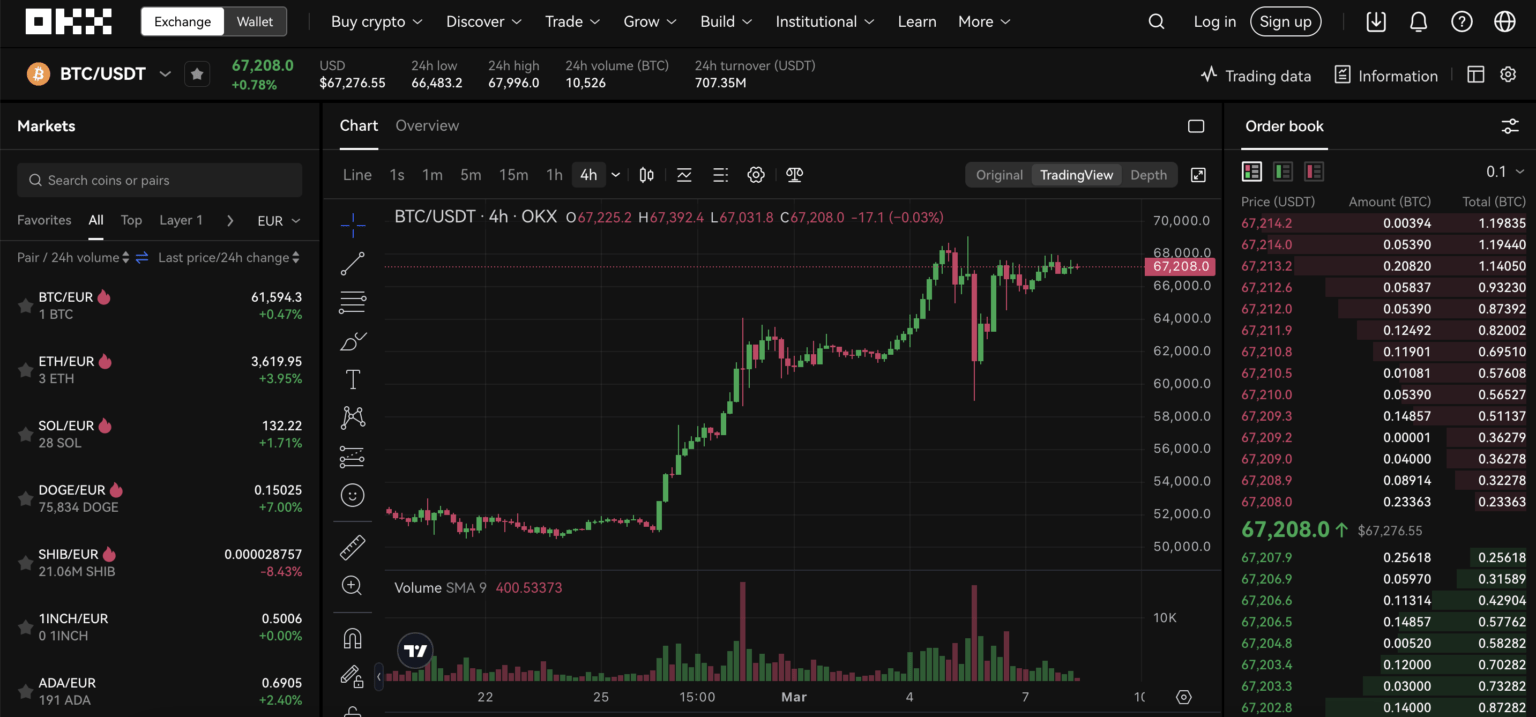
How OKX organizes spot, futures, and Web3: the mechanism
OKX operates as a hybrid: a centralized exchange (CEX) for spot, margin, and derivatives trading, plus a Web3 stack (non-custodial wallet, NFT marketplace, and DEX aggregator). Mechanically, that means your account can hold centralized deposits (custodied by OKX and largely stored in air-gapped, multi-signature cold wallets) and also connect to a self-custodial seed-based wallet for decentralized apps. For most US users the entry point is a KYC-verified account—OKX requires government ID and a facial liveness check—so the first layer of identity is centralized and regulatory-compliant.
Spot trading on OKX moves assets you’ve deposited into the exchange’s custody ledger; orders execute on an internal matching engine and settlement is immediate on the platform ledger. Margin trading borrows against these custodial balances and offers up to 10x leverage via isolated or cross margin modes (a practical ceiling that matters for risk management). Derivatives—futures, perpetuals, and options—are native to the CEX environment and can provide much higher nominal leverage (perpetuals up to 125x for some products). The Web3 side is separate: a non-custodial wallet gives you direct control of private keys and connects to DEXs, NFT marketplaces, and layer-2s; that wallet can also be linked to the OKX interface for smoother transfers between custody modes.
Why the differences matter in a login session
When you log in to OKX you’re not only authenticating a browser session—you’re asserting control across two paradigms. For CEX activity (spot, margin, futures) your authentication path is KYC + password + mandatory 2FA (SMS, Google Authenticator, or biometrics on mobile). For Web3 actions that involve your non-custodial wallet, login shifts to seed phrase possession or hardware wallet confirmation. Each path carries distinct failure modes.
Trade-off summary: using CEX custody gives faster trading, centralized risk controls (like withdrawal multisigs and cold storage), and easier fiat on/off ramps; but it exposes you to centralized operational risks (exchange outages, withdrawal freezes subject to procedures). Using the Web3 wallet grants self-sovereignty and direct DeFi access, but exchanges of custody (moving funds between your non-custodial wallet and OKX custody) expose you to on-chain risks and irreversible mistakes—gas fees, wrong-chain transfers, or lost seed phrases.
To make the login session concrete: if you plan to change a high-leverage futures trade, you must ensure your CEX login is secure and operational. If you intend to bridge funds quickly for an on-chain opportunity, the Web3 wallet must be ready and the bridge path tested. Both require different pre-flight checks—confirm 2FA works, verify withdrawal whitelist settings, and, for Web3, confirm hardware wallet firmware and seed availability.
Security architecture and the real risks
OKX emphasizes cold storage (over 95% of user assets in air-gapped, multi-signature wallets) and Proof of Reserves transparency. That combination reduces the probability of aggregate custodial theft, but it doesn’t eliminate personal attack surfaces. Here are the main categories and how they matter during login:
– Credential and phishing risk: Even with strong server-side security, users remain vulnerable to credential harvesting and spoofed domains. During login, always inspect the URL, beware of lookalike pages, and prefer the official app with biometric locks. A stolen password + 2FA via SIM swap remains a practical risk—hardware 2FA and app-based authenticators are safer than SMS.
– Self-custody risk: If you use the non-custodial Web3 wallet, losing the seed phrase is permanent—there is no “forgot seed” flow. Conversely, a compromised seed means immediate on-chain loss with no recourse. Hardware wallet integration reduces this risk, provided you maintain the device’s physical security.
– Smart contract and bridge risk: When moving assets between chains or using DeFi via the OKX DEX aggregator, you add smart contract risk. Even reputable aggregators route through third-party protocols; an exploit or faulty bridge can lead to loss despite a secure login.
Futures: leverage mechanics and failure modes US traders should know
Futures and perpetual swaps on OKX allow traders to express directional bets with margin and use sophisticated order types. Mechanically, leverage multiplies both gains and losses and changes margin maintenance dynamics. Two important points are often misunderstood by newcomers:
1) Cross margin vs isolated margin: cross margin shares collateral across positions, reducing liquidation risk for a group of positions but increasing systemic exposure—one bad trade can eat available margin for others. Isolated margin caps the downside to a specific position but may require frequent manual adjustments. For intraday traders, isolated margin is often preferred for clearer, position-level risk limits.
2) Funding rates and long-term cost: perpetual swaps use funding payments between longs and shorts to anchor the contract price to spot. High funding rates can turn a profitable directional view into a losing carry over time. Futures pricing mechanics (quarterly vs perpetual) create different carry and basis behaviors—know which product you’re using before you log in and hammer “close.”
Operational failure modes: liquidation can happen faster than you expect during high volatility, and slippage can widen on low-liquidity contracts. If the exchange has an outage at a critical time, centralized counterparties’ mechanisms—insurers, auto-deleveraging ladders, or insurance funds—kick in, but none are substitutes for prudent position sizing. For US traders who prefer regulated clarity, remember that KYC constraints make quick account opening (or a second backup account) less flexible than some international peers might experience.
Spot trading and Web3 interactions: complementary but distinct
Spot is straightforward: buy low, sell high. But its operational advantages are practical: immediately tradable balance, margin collateral for cross-margin positions, and eligibility for staking or yield products within the platform. The Web3 wallet’s strength is composability—you can move an asset to a chain where yield opportunities exist, mint NFTs, or interact with DeFi protocols not available directly in the CEX. The trade-off is operational friction and risk: each on-chain transfer costs gas and is irreversible.
If you’re logging in to move funds from OKX custody to your non-custodial wallet before connecting to a DApp, do a dry-run with a small amount. Confirm network selection on both sides—sending ERC-20 tokens to a Solana address is fatal. Keep hardware wallets updated and transactions verifiable on-chain. These are banal but effective mitigations against common, expensive mistakes.
Decision framework: a three-question heuristic for logins
Before you authenticate and act, run these three quick checks aloud or in your head. They reduce cognitive friction and focus the right safeguards into your session.
1) What am I trying to accomplish? (Close a futures position, adjust spot allocations, or move funds on-chain.) If it’s time-sensitive trading, favor the CEX path; if it’s access to composable yields, favor Web3 but accept the transfer delay.
2) What is the worst-case immediate failure? (Forced liquidation, stolen credentials, irreversible bridge loss.) If the worst-case is faster than your ability to respond, reduce size or use isolated margin.
3) What safeguards are in place for recovery? (2FA configured, withdrawal whitelist, hardware wallet backups.) If a safeguard is missing, pause and fix it before proceeding.
These heuristics are banal but they align choices with the actual constraints of the different systems—latency, reversibility, and recovery options. They also help you choose the when and how of logging in: for futures, log in via the app with stable internet and a verified 2FA method; for Web3 operations, prepare hardware wallet confirmations and confirm gas and bridge routes.
What to watch next (signals, not predictions)
Key signals that will affect the relative attractiveness of OKX’s offerings for US traders include: regulatory shifts on derivatives and custody in the US (which could change product availability and KYC depth), developments in cross-chain bridging security (exploit frequency, formal audits, and insurance products), and liquidity trends in major perpetual markets (which affect slippage and funding rates). The recent platform messaging that highlights buying BTC, ETH, and Web3 exploration speaks to a continuing push to integrate CEX convenience with Web3 capability; watch for incremental product changes and clearer guardrails around on-chain bridging.
Conditional scenario: if regulators impose stricter custody requirements for US users, expect tighter withdrawal controls or product restrictions—this would increase the value of a non-custodial wallet but also raise the bar for safe on-chain operation. Conversely, improvements in bridge security and wider hardware wallet adoption could make on-ramp/off-ramp between OKX custody and Web3 more practical for mid-sized traders.
FAQ
How should a US trader decide between trading spot and trading futures on OKX?
Decide based on time horizon and risk tolerance. Use spot for long-term allocation and custody benefits (staking, lower maintenance risk). Use futures for short-term directional bets, but enforce strict position sizing and prefer isolated margin if you want to limit spillover risk. Always confirm margin and liquidation thresholds before increasing leverage.
Is the OKX Web3 wallet safer than leaving funds on the exchange?
“Safer” depends on threat model. The exchange’s cold storage and multi-signature withdrawals protect against centralized hacks but require trust in the exchange’s operational integrity. A Web3 wallet gives you sole control, removing counterparty risk, but imposes absolute responsibility for seed phrase security and on-chain transaction safety. For operational safety, many users adopt a hybrid: keep trading capital on the exchange for execution speed and maintain long-term reserves in a hardware-backed non-custodial wallet.
What are the quickest defenses against phishing when logging into OKX?
Use the official app or bookmark the official web URL, enable app-based 2FA (not SMS), activate withdrawal whitelists, and use hardware 2FA when possible. Before entering credentials, validate the domain and certificate, and consider a password manager to avoid manual typing into phishing pages.
How can I test bridging and chain transfers without risking much?
Do small-value test transfers, confirm transaction receipts on-chain, and verify recipient addresses and network selections twice. Prefer bridges with strong audit histories and consider using trusted DEX aggregator routes that minimize the number of contract hops. Factor in gas and slippage so the test reflects realistic costs.
If you are ready to practice the practical login and account safeguards described here, start with the platform’s official login and account page checklist for KYC, 2FA, and wallet connections—this step is what separates speculative plans from operational readiness. For guided access steps and the official login flow, you can find the link to the OKX login help and walkthrough here.
In short: treat OKX as a layered system. The exchange side buys you speed and custody conveniences; the Web3 side buys you composability and self-sovereignty. Your login ritual is where those worlds meet—so optimize that ritual for the specific failure modes of the activity you plan to execute. Do that, and you’ll reduce surprise risk and make faster, more confident decisions in volatile markets.