That sharp question reframes a common choice DeFi power users face when installing a new browser wallet: pick the slickest UX that removes friction, or pick the wallet that forces you to verify every mechanical detail of a cross-chain trade? Rabby positions itself as an answer that tries to bridge both priorities—fast, automatic network switching and a rigorous pre-signing simulation engine—so the practical question becomes which trade-offs matter for your threat model and workflows.
Below I walk through how Rabby’s extension works in practice for US-based DeFi users, compare it against familiar alternatives, and translate the mechanics into concrete security trade-offs and operational rules you can apply the next time you click “install” in Chrome or Brave. Expect a grounded explanation of mechanisms, a candid list of limits, and decision heuristics you can reuse.
How Rabby’s install-to-use path is different (mechanics first)
Installing Rabby as a Chrome/Brave/Edge extension follows the normal extension flow, but two engineered behaviors change the day-to-day: automatic network switching and transaction simulation. The first removes a common human error—being connected to the wrong EVM network when a dApp expects a different chain. Rabby detects the dApp’s network expectation and silently (or semi-silently) switches the active chain so the call and the signature target the correct RPC endpoint. Mechanistically, this is a convenience that reduces user friction but increases dependency on the extension’s detection logic: if the detection misidentifies the intended network, an otherwise safe action could be routed incorrectly.
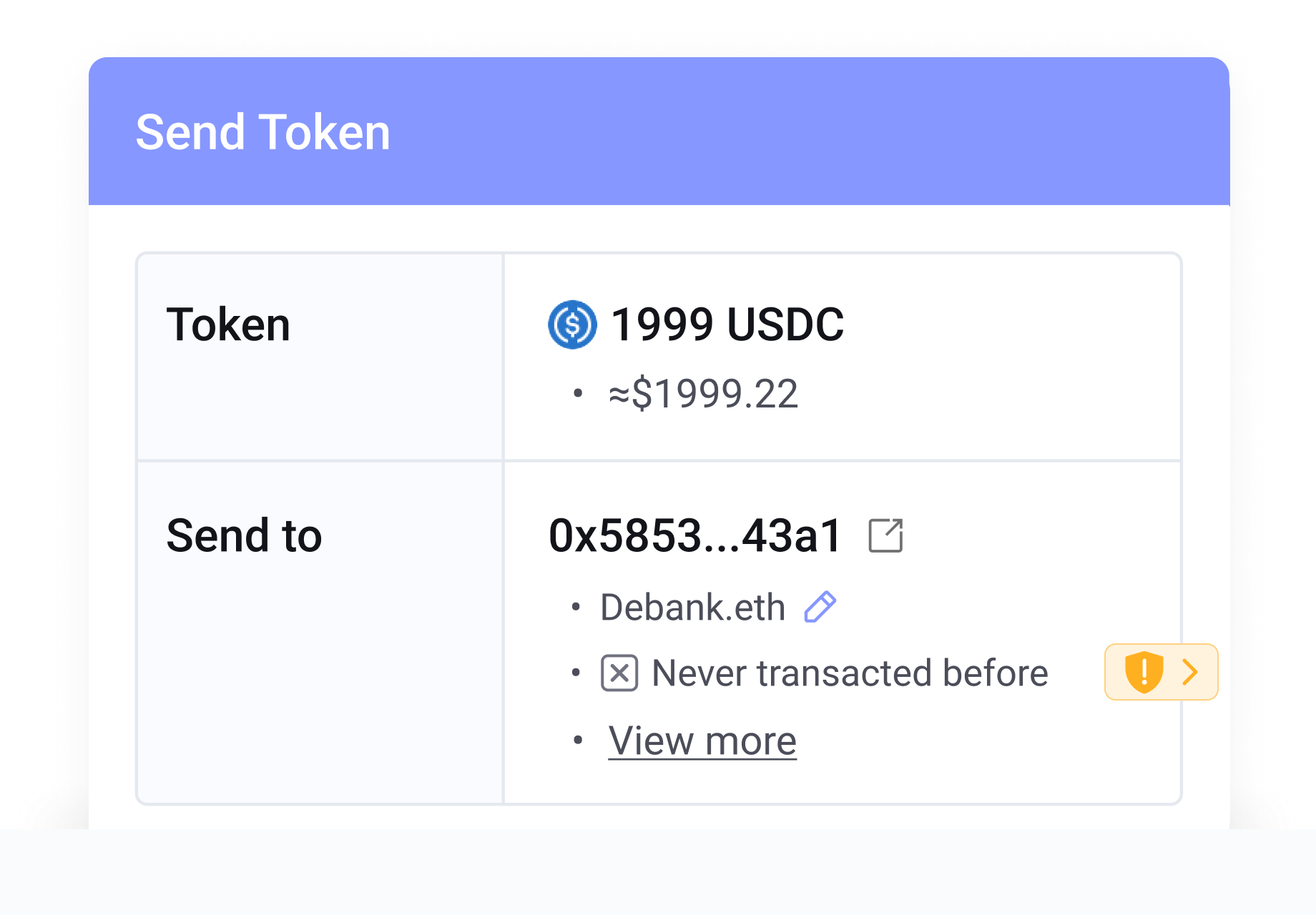
The second behavior—transaction simulation—is the more security-focused mechanism. Before you sign, Rabby runs a local or remote simulation of the transaction against the chain state and displays explicit estimates: token balance changes, fee costs, and flagged risks such as interactions with known-bad contracts or suspicious approval requests. This addresses “blind signing,” a core vulnerability in EVM wallets where users approve encoded calldata without seeing its effects. The simulation is not merely cosmetic: it translates binary calldata into human-readable balance deltas. That’s a meaningful step toward verifiable intent.
Side-by-side: Rabby extension vs. common alternatives (MetaMask, Trust Wallet, Coinbase Wallet)
Comparisons are most useful when you care about specific roles—solo trader, active LP manager, institutional signer, or hardware-backed custodian. Here are the trade-offs you should weigh.
Security-first features where Rabby leads: built-in pre-transaction risk scanning, transaction simulation, native approval revocation, extensive hardware wallet compatibility, and integrations with multi-sig/institutional providers. These features reduce attack surface in three ways: fewer blind-signs, easier remediation of lingering approvals, and the ability to keep high-value keys off the browser by using hardware or multi-sig.
Convenience and reach where others may win: MetaMask’s ubiquity and many onboarding paths, Coinbase Wallet’s fiat on-ramps, and Trust Wallet’s mobile simplicity. Rabby lacks a built-in fiat on-ramp and does not yet have native staking inside the wallet—so if your priority is buying ETH with a card inside the wallet or delegating tokens to a validator without leaving the app, you’ll need external services or workarounds.
Behavioral trade-off: Rabby’s automatic network switching reduces mistakes but adds an automation layer that must be correct. MetaMask makes you flip networks manually more often—friction that sometimes acts like a safety interlock. Choose automation when the tool’s detection is reliable for your dApps; otherwise prefer a tool that forces explicit network choices.
Where Rabby’s security model actually changes outcomes
Three concrete mechanisms alter real risk: transaction simulation, pre-transaction scanning, and approval revocation. Together they shift risk from “unknown” to “known-but-managed.” For example, a token approval that lets an AMM pull unlimited tokens is a persistent exposure. Rabby surfaces those approvals and gives you a native revocation flow in the extension; that materially reduces the window of exploitation if a counterparty or a dApp becomes hostile.
The simulation reduces the probability of catastrophic errors during complex multi-step DeFi operations—like leveraged position adjustments, permit-based swaps, or complex router calls—by giving you an explicit preview of balance deltas. That said, simulations depend on accurate chain state and predictable contract behavior. Transactions that rely on off-chain oracles, or that include non-deterministic logic (reverts that change with block timing), can still surprise you despite a successful simulation. So simulation lowers but does not eliminate risk—treat it as a strong diagnostic, not an infallible oracle.
Known incidents and how they inform trust
Rabby’s history includes a 2022 exploit of a Rabby Swap smart contract with roughly $190,000 lost. Important lessons follow: one, non-custodial wallets are not immune to bugs in integrated contract code; two, the team’s response—freezing the contract and compensating users—offers evidence of operational maturity and active incident response; three, open-source code and third-party audits are necessary but not sufficient. Use these facts to form a risk posture: trust the wallet’s tooling to reduce human error, but mitigate systemic smart-contract risk with compartmentalization and small-batch testing.
Operational rules for installing Rabby in Chrome (practical step-by-step)
Here’s a short, decision-useful checklist US-based DeFi users can apply when adding Rabby as a browser extension:
1) Install only from the official store or the project’s verified location; confirm the extension’s publisher and review recent user reports. 2) Import or create a wallet but immediately connect a hardware wallet for larger balances—Rabby supports Ledger and several other vendors. 3) Use the Flip toggle if you need to test MetaMask compatibility: keep a distinct account for high-risk experiments. 4) Before approving any multi-step DeFi transaction, inspect Rabby’s simulation output: verify token deltas, recipient addresses, and fee estimates. 5) Regularly audit active approvals from the native revocation tool—this reduces persistent exposure to compromised contracts. 6) For institutional use, prefer multi-sig integrations (Gnosis Safe, Fireblocks) as the primary signing authority and use Rabby as a UX layer rather than the custody layer.
Decision heuristics: when Rabby is the right fit
Choose Rabby if you:
– Execute frequent, multi-chain DeFi trades and value automatic network switching to avoid accidental cross-chain failures. – Need clear, pre-sign previews because you sign complex calldata (e.g., router swaps, limit orders, permit flows). – Manage approvals actively and want a built-in revocation interface. – Use hardware wallets or multi-sig services for custody, and want a browser extension that integrates with those solutions.
Avoid or delay Rabby if you:
– Rely on in-wallet fiat purchases or native staking features. – Require a wallet ecosystem where every dApp expects MetaMask-style behavior and you prefer minimal automation. – Are unwilling to accept the residual risk that simulations and scans cannot anticipate every oracle or time-dependent edge case.
What to watch next (signals that matter)
Monitor three forward-looking signals to know whether Rabby deserves a larger role in your stack: (1) additions to on-ramp partnerships or native staking support; (2) third-party audit cadence and transparency about simulation methodology; (3) frequency and resolution quality of any future incidents. The wallet’s open-source MIT license is a favorable structural point: it enables external audits and community review, but audit reports and responsible disclosure practices are the real currency you should track.
If Rabby expands fiat pathways or builds native staking, its convenience profile will shift closer to all-in-one wallets—but those same additions change the attack surface and require new mitigations. Conversely, stronger institutional integrations (more custody providers, more multi-sig automation) would increase Rabby’s fit for treasury operations without changing the trust model for retail users.
FAQ
How do Rabby’s transaction simulations protect me from scams?
Simulations turn opaque calldata into explicit balance deltas and fee estimates. That catches common scams where a malicious contract steals tokens via an approval or where a swap route sends tokens to an unexpected contract. However, simulations rely on deterministic contract behavior and chain state; they can miss attacks that exploit off-chain inputs, oracle manipulation, or block-dependent logic. Use simulation as a front-line diagnostic, then combine it with small test transactions and hardware signing for high-value operations.
Is automatic network switching safe, or does it introduce new risks?
Automatic switching reduces the human error of being on the wrong chain, which prevents failed transactions and accidental mainnet interactions on testnets. The risk is a false positive: if the extension misidentifies the intended network or a dApp’s expected chain, your transaction could go to an unintended RPC. Mitigate this by checking the dApp’s URL and the simulated transaction details before signing and by keeping a separate account for experimental sites.
Can Rabby replace a hardware wallet or multi-sig for institutional custody?
No—Rabby complements custodial solutions rather than replacing them. It integrates with hardware wallets and multi-sig providers, providing improved UX and simulation capabilities while keeping keys off the browser. For institutional treasury, the recommended pattern is to use Rabby as an interface layer over a hardware or multi-sig custody backend, not as the primary key holder.
Where do I install Rabby and how do I get started quickly?
Install the extension on a Chromium-based browser (Chrome, Brave, Edge), then import or create an account. For safe practices, immediately connect a hardware wallet for larger balances and run a small test transfer before using complex dApps. For the official starting point and links, see rabby.
Bottom line: Rabby changes the calculus for many active DeFi users by converting opacity into inspectable simulations and by reducing simple human errors through automatic network switching. Those are real advances. They lower—but do not eliminate—systemic risks that come from smart contracts, oracles, and the broader DeFi stack. Use Rabby’s strengths to harden operational discipline: pair it with hardware or multi-sig custody, run small test transactions, and treat simulation outputs as a diagnostic step in a multi-layered defense-in-depth approach.