Imagine it’s 9:15 AM Eastern, Bitcoin is ripping higher, and you’re halfway through a coffee when a price alert fires. You need to sign in to your exchange, confirm an order, and—if things get messy—move a position to a safer wallet. That half-minute of friction can cost money or create security headaches. This article walks through that concrete scenario using OKX as the case study: how its login and account-protection mechanisms work, how those choices matter for trading speed and safety, and how the exchange’s Web3 tools change the calculus for traders who also use decentralized apps.
The goal is not marketing. It is to give US-based crypto traders a technocratic mental model: what happens during sign-in, why certain options exist, where the system can fail, and simple heuristics you can use before you click “confirm.” I’ll correct common misconceptions about single-sign-on convenience versus custody, explain trade-offs between speed and security in derivatives trading, and flag practical limits you should watch when using OKX’s combined CEX and Web3 surface.
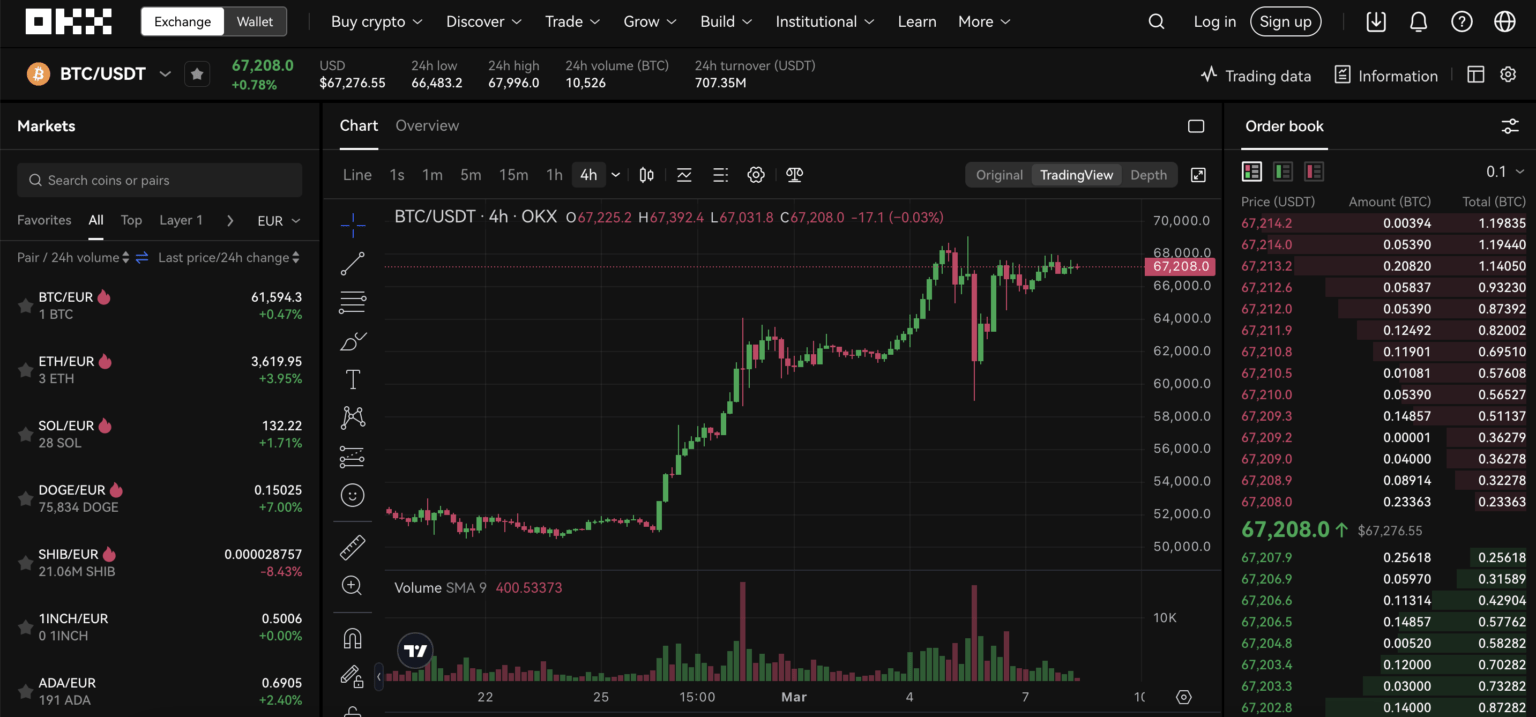
How OKX Sign-in Works: Mechanisms and Why They Matter
Signing into OKX is not just entering a password. At the protocol level there are three interacting systems: identity verification (KYC), session and device authentication, and two-factor or biometric second factors. For US users the KYC process requires a government ID and a liveness check; that makes account creation slower but anchors the account to a verifiable identity—important for compliance and for some fiat rails. Session management uses encrypted tokens and AI-driven detection of anomalous logins; 2FA (SMS, Google Authenticator) or biometric unlocks on mobile provide the second layer.
Why this matters for traders: speed and reliability of login determine your ability to act in fast markets. Biometric login on mobile and persistent sessions on desktop trade off convenience for a slightly larger attack surface: a long-lived session token is convenient, but if your machine is compromised it can be abused. That’s why OKX combines mandatory 2FA with threat detection—each mechanism closes a different kind of gap.
Practical nuance: using hardware security (device biometrics, hardware security keys integrated into the platform or WebAuthn where available) reduces phishing risk more than SMS 2FA. However, hardware keys add setup friction and can complicate emergency access. For US traders who need both speed and resilience, a reasonable pattern is: keep one high-trust device (secure home desktop with hardware key and strong OS protections) for large adjustments and a mobile device with biometric login for quick, authenticated actions.
Logging In and Trading: Speed vs. Safety Trade-offs in Practice
Once you’re through login, trading on OKX—spot, margin, futures, or options—depends on two performance layers: exchange-side order matching and your own endpoint latency. OKX supports advanced TradingView charting on web and native apps that include algorithmically managed orders; but the fastest path from decision to execution is often the simplest: limit orders on a dedicated, well-provisioned browser session or app with minimal extensions. Complexity (multiple widgets, third-party tools, browser extensions) increases the risk of UI confusion or delays during volatile moves.
Some common myths corrected: 1) “High leverage equals smart use of margin.” Reality: leverage amplifies both gains and losses and interacts with liquidity and funding rate mechanics. OKX offers up to 125x on specific futures; the platform’s risk engine and margin modes (isolated vs cross) determine when a liquidation happens. 2) “Proof of Reserves makes exchanges risk-free.” Proof of Reserves provides transparency about aggregate backing, not an insurance against operational failures, regulatory freezes, or user-specific social-engineering losses.
For US traders, regulatory uncertainty can translate into operational limits—withdrawal holds, enhanced KYC requests, or temporarily restricted products. That’s a boundary condition: even a perfectly secured account can be affected by compliance-side controls outside your technical reach.
Web3 on OKX: When Custody and Non-Custodial Tools Collide
OKX is both a centralized exchange and a Web3 hub. It provides a custodial CEX account and a separate non-custodial Web3 wallet where you control the private keys via a seed phrase, plus hardware wallet integrations (Ledger, Trezor). This duality creates real choices. When you trade on the CEX, assets are in cold storage or hot wallets under OKX’s custody—over 95% of assets are reported held in offline, multi-signature cold wallets—reducing exchange-level hack risk. But when you interact with DeFi—staking, yield farming, or NFTs—you often leave the CEX custody model and assume smart-contract and private-key risks yourself.
Mechanism-first takeaway: treat custody as a binary decision for each asset or activity. If you need immediate execution speed and margin capability, keep capital on the CEX with strong account protections. If you want to use composable DeFi strategies, move only the capital you can afford to lose into your non-custodial wallet—and use hardware signing. The two models solve different problems: CEX custody reduces custody risk and offers liquidity and derivatives; non-custodial wallets maximize composability and control but expose you to phishing and smart-contract risk.
OKX’s browser extension and DEX aggregator reduce friction for cross-chain swaps and DApp interactions, but they also create phishing vectors—particularly in browser environments. A practical heuristic: verify the origin of any signing request, maintain a minimal set of installed extensions, and prefer hardware wallet confirmations for significant on-chain actions.
Where the System Breaks: Risks, Limits, and Failure Modes
Trading risks are not hypothetical: slippage, low liquidity, and sudden funding-rate flips can create rapid, material losses. OKX lists more than 300 supported assets and 130 blockchains; that breadth increases opportunity but raises liquidity and execution risk for less popular tokens. Perpetual swaps with high leverage are especially sensitive to liquidity gaps—orders that look small on paper can sweep order books and trigger cascading liquidations.
Operational risks include account compromise, lost seed phrases for the non-custodial wallet, and external smart-contract exploits. Even with Proof of Reserves and cold-storage practices, systemic or social-engineering incidents can lock funds or trigger compliance holds. A final boundary condition: proof that the exchange has reserve assets does not guarantee instant user-level access in every scenario—regulatory or legal actions can change user experience quickly.
Decision-Useful Heuristics: A Compact Checklist Before You Trade
1) Authentication posture: Use hardware-backed 2FA where possible; avoid SMS as the sole second factor. 2) Session hygiene: maintain one “hot” trading device, keep it patched, and restrict extensions. 3) Order choice: for fast markets prefer limit orders; use market orders only when immediacy outweighs potential slippage. 4) Leverage rules: cap leverage by the liquidity of the instrument (lower on thinly traded alt futures). 5) Custody split: keep capital for active margin trading on the CEX, migrate a reserve into a hardware-backed non-custodial wallet for long-term staking and DeFi. These heuristics balance speed, liquidity, and security in the typical US trader context.
If you want a focused start to the sign-in and login process for OKX specifically, the exchange’s official step-by-step login workflow and KYC guidance remain the authoritative how-to; an accessible portal that aggregates those details is available here: okx.
What to Watch Next: Signals and Conditional Scenarios
Look for three near-term signal classes that will change the trade-space. First, regulatory guidance in the US about derivatives and listed tokens—tighter rules could reduce available instruments or change margin rules. Second, cross-chain tooling and DEX liquidity—improvements will lower slippage for non-native pairs and make on-chain exits faster. Third, usability changes in authentication (broader WebAuthn adoption, passkeys) that could materially reduce phishing risk. Each of these, if they move, will alter the speed-security trade-offs described above; treat them as conditional scenarios rather than forecasts.
Finally, monitor funding rates and open interest on leveraged products: when both climb sharply, liquidation risk across the market rises. Those are practical, measurable signals that tell you to reduce leverage or increase margin buffers.
FAQ
Q: How quickly can I regain access if I lose my OKX account credentials?
A: Restoration depends on what you lose. If you misplace your password but retain 2FA devices and KYC ID, OKX’s account-recovery flows typically allow verification and reset. If you lose access to your 2FA and cannot complete identity checks, recovery becomes slower and more manual—especially in the US where stricter KYC rules apply. For non-custodial wallets, loss of a seed phrase is effectively permanent. That difference underscores why traders should separate operational funds on the exchange from long-term holdings in a hardware-backed wallet.
Q: Is logging in from multiple devices unsafe?
A: Multiple devices increase convenience but also expand the set of endpoints an attacker could target. The risk is manageable if every device is secured (OS updates, unique strong passwords, hardware-backed 2FA). For high-value accounts, minimize devices and prefer hardware keys or biometric unlock with device encryption.
Q: Should I use OKX’s non-custodial wallet or keep everything on the exchange?
A: Use the exchange for active trading and margin needs where liquidity and speed matter; use the non-custodial wallet for DeFi interactions, long-term staking, or when you require direct control of keys. Never mix the two mental models casually: transferring large sums back and forth increases exposure to operational error and phishing.
Q: Do Proof of Reserves eliminate counterparty risk?
A: No. Proof of Reserves increases transparency about asset backing but does not remove legal, operational, or access risks. It also cannot protect individual accounts from social-engineering attacks or regulatory holds.