Which login path on OKX gives the best balance between convenience, custody control, and regulatory compliance? That question reframes what many traders treat as a simple UX choice: “Do I create a verified account, use a Web3 (self-custodial) wallet, or try a lightweight guest/quick-entry route?” The answer matters because each route rearranges the trade-offs among access to features, legal identity, custody risk, and security controls — and those trade-offs determine what you can trade, whether you can withdraw fiat, and what happens if something goes wrong.
This article compares three practical alternatives — fully verified OKX accounts (KYC), the OKX Web3 non-custodial wallet, and quick or guest login options — and it gives decision rules you can use immediately. I draw on OKX’s platform design (CEX + Web3 wallet + NFT and DeFi hub), recent product positioning, and the security and regulatory mechanics that drive user outcomes for U.S.-based traders.
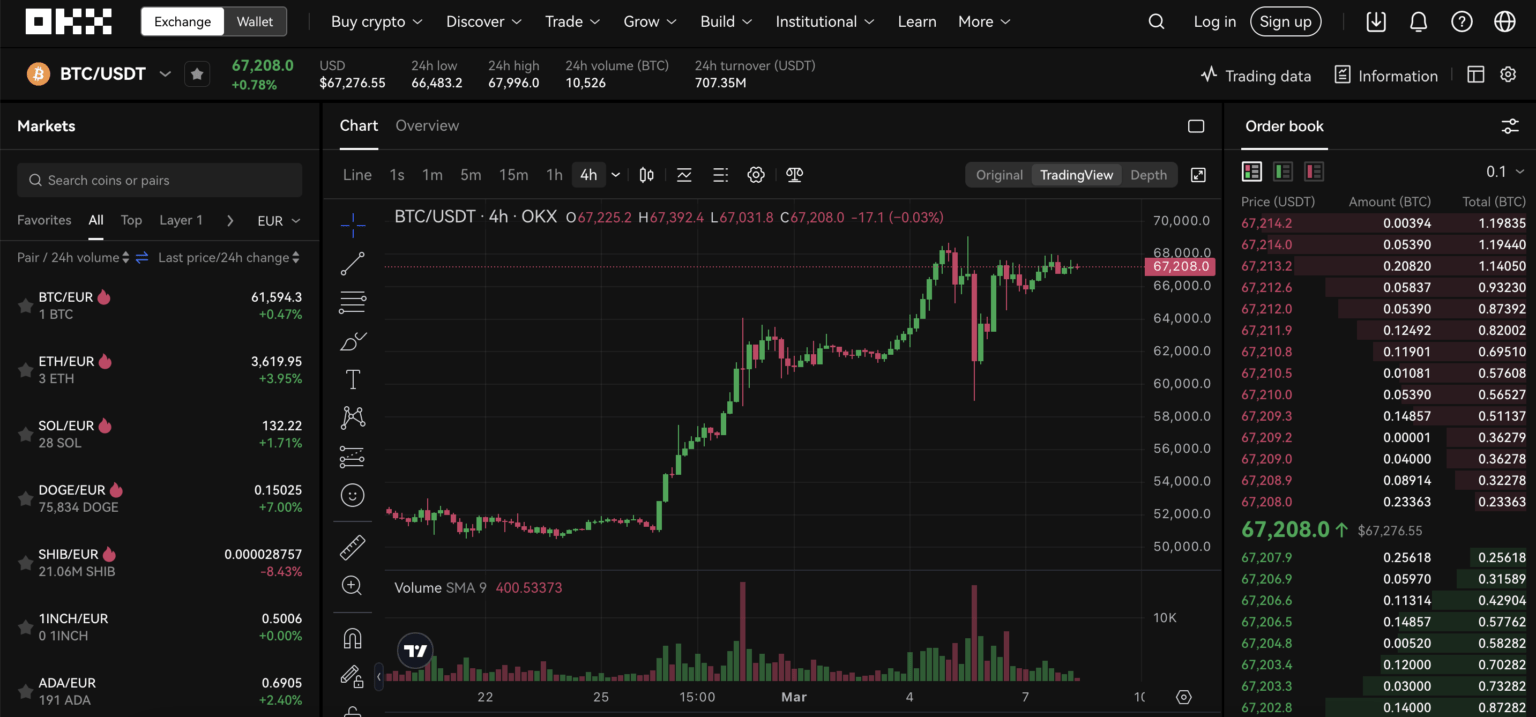
Option A — Fully verified (KYC) OKX account: what you get and what you surrender
Mechanics: A verified OKX account requires submitting government ID and completing a facial liveness check. Verification unlocks fiat on-ramps, full trading (spot, margin, futures, options), staking with platform custody, and fiat withdrawals. It also enables higher leverage tiers and institutional features for eligible users.
Why it matters: KYC is the entry key to the centralized side of OKX where Proof of Reserves (PoR) and cold-storage governance apply. OKX publishes PoR data that lets users confirm on-chain backing, and the platform stores the majority of assets in multi-signature cold wallets. For most active US traders who want fiat rails, leverage, or institutional custody assurances, KYC is effectively non-negotiable.
Trade-offs and limits: KYC reduces anonymity and exposes you to jurisdictional controls (e.g., account freezes under legal orders). It also centralizes custody by design — you trade the convenience of recoverable accounts and fiat access for reliance on the exchange’s operational security. While OKX deploys military-grade encryption and AI-driven login monitoring, centralized custody still creates a single point-of-failure compared with self-custodial approaches.
Option B — OKX Web3 non-custodial wallet: control with different risks
Mechanics: The OKX Web3 wallet is self-custodial: you hold a seed phrase, integrate Ledger/Trezor hardware if you wish, and connect to DeFi apps. It supports many chains (130+ native blockchains) and the DEX aggregator routes swaps across liquidity pools. Crucially, the wallet does not require KYC to hold funds locally or to interact with many dApps.
Why it matters: Self-custody restores the canonical crypto trade-off: you control keys and therefore funds, removing exchange custody risk and many regulatory frictions. This is attractive if your primary goal is DeFi yield farming, NFT minting, or cross-chain swaps where tight on-chain control matters.
Trade-offs and limits: Self-custody shifts operational risk onto you. Losing a seed phrase is permanent loss; phishing and smart-contract exploits are real hazards. The wallet does not provide the same fiat rails or margin/futures access as a verified CEX account. Also, while OKX supports hardware integrations, using them requires additional setup and discipline.
Option C — Guest or quick login: convenience at constrained capability
Mechanics: Guest routes — whether via temporary session access or reduced-auth flows — are designed for rapid testing or viewing markets. They may allow lightweight trading but typically restrict withdrawals, fiat transfers, and higher-risk products until verification is completed.
Why it matters: A guest login is useful for onboarding, quick market checks, or experimentations with the UI. For US traders it is a pragmatic short-term option when you want to evaluate features before committing personal ID. It also reduces exposure of identity data during initial exploration.
Trade-offs and limits: Guest access is deliberately limited. You cannot use it as a substitute for full account capabilities: no fiat withdraws, no high-leverage products, and limited staking options. Depending on the platform’s anti-abuse checks, guest sessions may be rate-limited or monitored by AI-driven threat detection.
Direct comparison — a decision map for the US trader
Here are simple decision rules that turn the conceptual trade-offs into practical choices.
– Want fiat ramps, leverage, institutional features, and recoverable accounts? Choose verified KYC. Accept regulatory visibility and centralized custody.
– Want maximum on-chain control, permissionless DeFi access, and hardware-wallet integration? Choose the OKX Web3 wallet. Accept that loss of seed phrase equals permanent loss and that you may have to bridge to a CEX later for fiat conversions.
– Unsure, exploring, or comparing interfaces? Use guest login to test the environment, then graduate to KYC or Web3 depending on your needs.
Security mechanisms and practical mitigations
Mechanisms: OKX blends cold-storage multi-sig (95%+ offline), PoR transparency, AI threat detection, and mandatory 2FA to reduce attack surface. For self-custodial wallets, hardware wallets and careful DApp vetting reduce smart-contract and phishing exposures.
Practical mitigations:
– For KYC accounts: enable strong 2FA (prefer hardware or authenticator apps over SMS), whitelist withdrawal addresses, and use device-level biometrics only on trusted devices.
– For Web3 wallet users: use a hardware wallet for large balances, keep a secure offline backup of your seed phrase, and use a separate wallet for high-risk DeFi interactions.
Non-obvious distinctions and a sharper mental model
Many traders conflate “security” with “safety.” Security is about controls and hardening (2FA, cold storage, PoR). Safety is about what happens when things fail: recoverability, recourse, and legal protections. KYC + CEX custody improves recoverability and recourse; self-custody improves legal insulation and control but makes recovery practically impossible if you lose keys. Make explicit which you prioritize before choosing.
Another common misconception: PoR equals absolute safety. Proof of Reserves shows on-chain backing at a point in time and improves transparency, but it does not eliminate counterparty risk from operational errors, internal fraud, or future policy-driven freezes. Treat PoR as a strong signal — not a guarantee.
What to watch next (near-term signals that matter)
– Regulatory shifts in the US around stablecoins and exchange custody rules could change withdrawal policies or KYC thresholds — watch regulatory guidance and OKX’s compliance updates.
– Integration improvements between the Web3 wallet and on-ramp services (bridges, fiat gateways) would lower friction for moving between self-custody and exchange custody; that would materially change the convenience calculus.
If you want a quick route to test the UI or begin the login process from a trusted resource, try the platform’s web login landing page: okx login.
FAQ
Do I need KYC to use the OKX Web3 wallet?
No. The OKX Web3 wallet is non-custodial and does not require KYC to hold assets or to interact with many dApps. However, converting to fiat, using certain exchange products, or withdrawing to bank accounts requires a verified exchange account.
Does Proof of Reserves mean my funds are risk-free on OKX?
No. PoR increases transparency by showing on-chain backing at specific times, but it does not remove operational, legal, or governance risks. PoR is a positive signal, not a legal indemnity against all forms of loss.
Which login option is safest from phishing attacks?
Technically, hardware-backed accounts (hardware wallet + Web3 wallet) minimize phishing losses because private keys are never exposed to the browser. For exchange accounts, strong 2FA and address whitelisting reduce phishing success. The “safest” choice depends on whether you value recoverability (CEX) or key isolation (hardware + Web3).
Can I switch between the Web3 wallet and a verified OKX account?
Yes. You can move assets between the Web3 wallet and a verified OKX account, but expect on-chain fees and potential bridge steps for cross-chain assets. Plan for timing and slippage when transferring during volatile markets.