Surprising fact: a platform can hold 95% of assets in air-gapped cold storage and still leave users exposed to the single most common failure mode — human operational error. That tension sits at the heart of how OKX packages a centralized exchange (CEX), a self-custodial Web3 wallet, and a trading terminal into one product. For US-based traders deciding whether to log in and trade on OKX, the choice is less binary than “custodial vs non-custodial.” It’s a stack of risk trade-offs: custody model, login hygiene, trading strategy, and where you place liquidity and collateral.
This commentary explains how OKX’s wallet, account, and exchange pieces fit together, what they protect you from, where they stop working, and how to make practical choices that match your trading goals. I’ll compare OKX’s integrated model with two alternatives (pure CEX custody and full self-custody), highlight a few persistent limits, and offer decision heuristics you can reuse when evaluating any exchange or wallet.
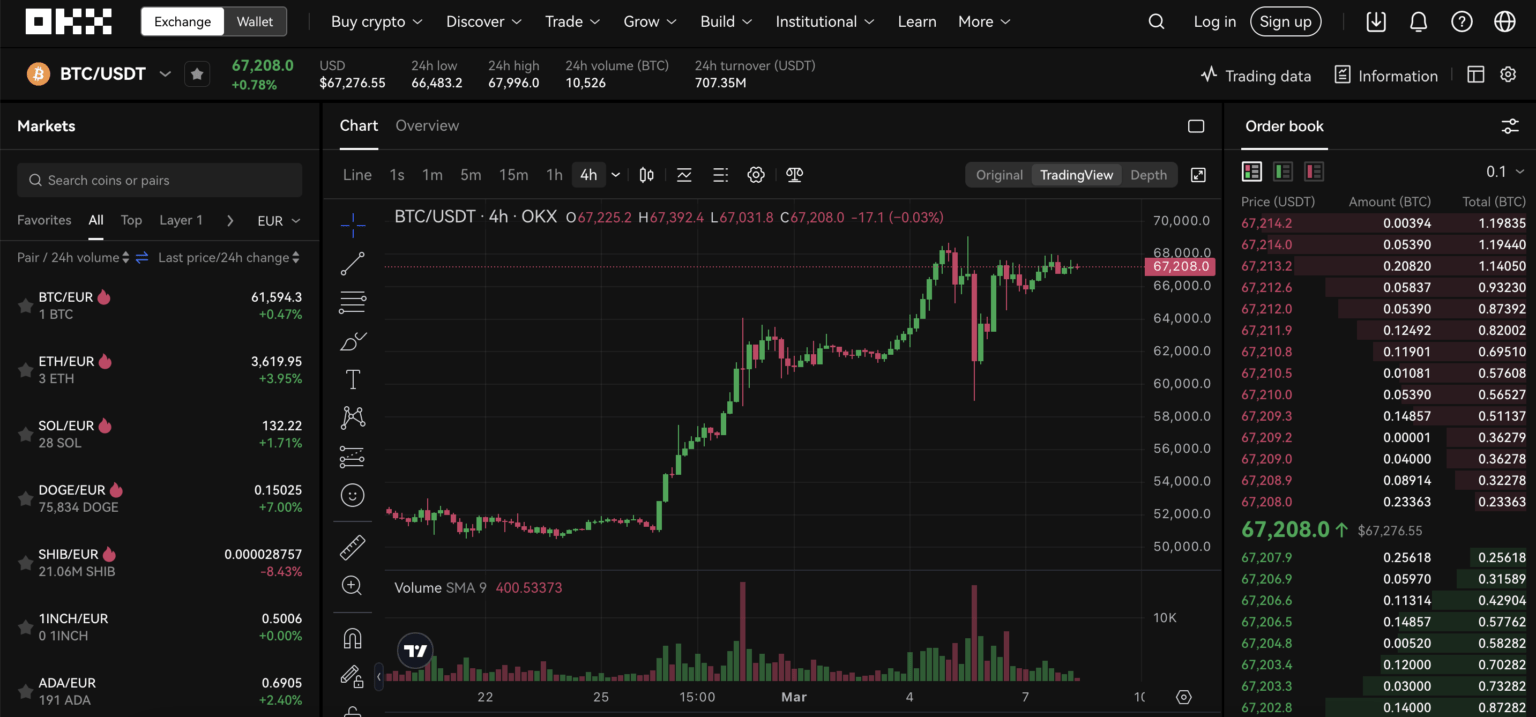
How the pieces work together: mechanism, not marketing
OKX combines a centralized exchange ledger (the CEX platform where you place spot, margin, futures, and options orders) with a Web3 wallet (non-custodial seed-based wallet, browser extension and mobile app) and auxiliary services like staking, an NFT marketplace, and a DEX aggregator. Mechanically, that means three different custody and operational regimes co-exist on one interface:
– Centralized custody: when you deposit assets into your OKX account, they are recorded on OKX’s internal ledger and — critically — the exchange claims to hold reserves in cold storage. Its Proof of Reserves (PoR) mechanism allows on-chain verification that user deposits are backed 1:1 by assets under custody. This is an institutional control that reduces counterparty insolvency risk, but it does not remove counterparty risk entirely (platform governance, withdrawal policies, or regulatory actions can still affect access).
– Non-custodial Web3 wallet: OKX’s wallet gives you a seed phrase and local private-key control. That means you own keys, can connect to hardware wallets (Ledger, Trezor), and interact with DApps directly. The trade-off is classic: absolute control for absolute responsibility. Lose the seed, and recovery is effectively impossible.
– Cross-product plumbing: the interface permits moving assets between these regimes, using the DEX aggregator for cross-chain swaps or moving funds to margin and derivatives. That convenience shortens operational paths but adds surface area for errors: a misplaced transfer, a wrong network choice, or an approval to a malicious contract can convert a simple login into a security incident.
Account login and protections — strong, but not foolproof
OKX uses military-grade encryption, AI-driven login threat detection, mandatory Two-Factor Authentication (2FA), and biometric options on mobile. For US traders, those controls reduce automated account takeovers and make credential stuffing less effective. There’s also KYC and facial liveness checks which increase regulatory compliance and can deter bad actors.
However, the technical strength of these controls doesn’t eliminate several practical failure modes: phishing pages that mimic the login flow; SIM swap attacks that intercept SMS 2FA; social-engineering scams that trick support into an unwanted recovery; and the permanent loss of funds from mis-signed transactions in the Web3 wallet. Good defenses are layered, and a strong exchange login is only one layer.
Practical step: whenever you log in — whether on web or mobile — prefer hardware-backed or app-based authenticators over SMS 2FA, enable withdrawal allowlists if you trade large amounts, and treat any email about account changes as a potential signal to pause activity and audit your devices.
Trading features and the risk spectrum
OKX offers a broad product slate: spot trading, margin up to 10x, futures and perpetuals up to 125x, options, staking, and an NFT marketplace. The platform’s DEX aggregator and support for 130+ blockchains make cross-chain activity doable without switching tools. For traders this is powerful — one login exposes you to many markets and yield opportunities.
But breadth increases risk in two ways. First, leverage multiplies both gains and losses; a 10x margin or a 125x perpetual position that goes against you can wipe collateral instantly. Second, interacting with newer chains, low-liquidity tokens, or DeFi protocols exposes you to smart-contract risk and large bid-ask spreads. Liquidity risk is not binary: an asset might be tradeable in normal conditions and effectively untradeable during a crash.
Decision heuristic: allocate from the inside out. Keep short-term trading capital on the CEX ledger where you benefit from fast execution and cold-storage-backed custody. Move assets to the non-custodial wallet only when you plan to interact with DeFi protocols, mint NFTs, or manage long-term holdings that you prefer to control directly.
Comparing options: OKX integrated model vs two alternatives
Here are three archetypes and where each fits.
– OKX integrated model (CEX + non-custodial wallet): convenience for multi-product traders, rapid internal transfers, DEX aggregator access, and institutional features like PoR and cold-storage. Best if you value convenience without fully outsourcing custody. Sacrifices: larger attack surface and dependence on correct user behavior when switching custody modes.
– Pure CEX custody: platforms that do not offer a user-controlled seed; all assets remain on the exchange. Best for traders who prioritize execution speed and centralized protections and who accept counterparty risk. Sacrifices: no private-key ownership and potential withdrawal restrictions during stress events.
– Full self-custody: using hardware wallets and separate DApp interactions. Best for holders prioritizing absolute control and censorship resistance. Sacrifices: reduced convenience for active trading, moral hazard of irreversible user error, and the need for vigorous operational security.
None of these is strictly superior for every user. The right choice depends on time-horizon, trading frequency, risk tolerance, and operational discipline.
Where the system breaks — limits and unresolved risks
Three meaningful limits deserve emphasis. First, Proof of Reserves demonstrates backing at a point in time but does not guarantee real-time liquidity or that all assets are free of encumbrances. PoR reduces insolvency worry, but it is not a legal guarantee against freezes, seizures, or regulatory holds.
Second, AI-driven threat detection reduces noise but can generate false negatives or false positives. A perfectly calibrated detector is elusive; savvy attackers probe for gaps and novel social vectors. Third, the intersection of CEX and DeFi opens composability risk: a token held on the exchange might be used as collateral in internal risk models, and the same token traded on a DeFi protocol can be subject to smart-contract exploits. Composability is a feature for builders and a hazard for traders who don’t track counterparty and protocol linkages.
Watch for these signals: sudden withdrawal delays, unusual spikes in borrow rates for a token, or rapid changes in margin maintenance requirements. Each can indicate stress before prices move much.
Concrete login checklist for US-based traders
Before you click the login button, follow this checklist:
1) Confirm URL and certificate — bookmark the genuine site and use the official mobile app. For web access consider the official guide and links provided by the platform when possible; for quick access consider using the official help page for direct login instructions such as okx login rather than third-party search results.
2) Use an authenticator app (not SMS). 3) Link a hardware wallet for large balances or use withdrawal allowlists. 4) Limit on-exchange holdings to the capital you need for active trades. 5) Keep a separate, documented recovery plan for seed phrases stored offline. 6) Periodically review connected apps and approvals in the Web3 wallet to revoke stale permissions.
What to watch next — conditional scenarios, not predictions
If OKX or similar platforms deepen PoR transparency and combine it with real-time attestation of liquidity, the user trust equation shifts in favor of large on-exchange holdings for trading. Conversely, if regulatory pressure in the US tightens KYC or imposes asset custody rules that slow withdrawals, traders who need rapid access may prefer on-chain self-custody workarounds. Monitor three signals: further automation of PoR and attestation, changes in margin/withdrawal policy notices, and regulatory guidance on exchange custody standards.
Those developments would change tactical choices but not core trade-offs: convenience versus absolute control, and execution speed versus exposure to systemic platform risk.
FAQ
Is OKX safe to log into from the US?
OKX deploys strong technical controls—encryption, AI threat detection, and mandatory 2FA—and stores the majority of assets in multi-signature cold wallets. These reduce platform-level risk, but user security depends heavily on login hygiene (authenticator apps, hardware wallets) and protection against phishing or social attacks. Safety is layered; don’t treat a secure platform as a substitute for personal operational security.
Should I keep long-term holdings on OKX or in the OKX Web3 wallet?
Use a purpose-driven split: keep short-to-medium term trading capital on the exchange for execution and margin needs; place long-term holdings you intend to HODL in a properly secured self-custodial wallet or hardware device. If you prefer exchange convenience and yield (staking or auto-compounding), only do so with amounts you can tolerate losing access to in case of withdrawal freezes or regulatory action.
What are the biggest operational mistakes traders make when using integrated platforms?
Three common mistakes: (1) conflating on-exchange custody with self-custody and assuming the same recovery properties; (2) approving unlimited token allowances for DApps and forgetting to revoke them; (3) using SMS 2FA as the primary protection. Each mistake is avoidable with simple operational rules.
How should I think about leverage and margin on OKX?
Treat leverage as a tool for short-duration, well-defined plays, not as a substitute for risk management. Higher leverage shortens the time horizon in which adverse moves can liquidate you. Maintain margin buffers, understand maintenance margin mechanics, and prefer isolated margin for risk-limited experiments.