What does it actually mean when an exchange claims “full backing,” fast markets, and a single interface for CEX and Web3 — and why should a US trader care? That question reframes the routine choice between platforms. For active traders the issue is not only fees and token lists, but how custody, verification, and on-chain transparency interact with trading mechanics, margin rules, and the real operational risks that surface during volatile moves. OKX bundles many features that matter to a modern crypto playbook; understanding the mechanisms behind those features — and the limits they leave exposed — is what lets you use the platform without mistaking convenience for immunity.
In what follows I explain the operational design choices inside OKX (custody, PoR, login and verification), how those choices change trading behavior for spot, margin and derivatives, and the trade-offs US users should weigh when they decide how much to trust a centralized platform versus self-custody or decentralized alternatives. I also provide a short, practical checklist for logging in, completing verification, and reducing common operational risks.
How OKX is built: custody, transparency, and layered access
At the core, OKX is a hybrid platform: a centralized exchange (CEX) for order matching and custody, paired with Web3 tooling (a non-custodial wallet, NFT marketplace, DEX aggregator) that exposes decentralized rails. Mechanistically, that means most customer balances are held in multi-signature, air-gapped cold wallets (the platform reports over 95% cold storage), while hot wallets and matching engines provide liquidity and execution. The practical implication: when you trade, execution and margining happen inside the CEX environment — which offers speed and order-book depth — but withdrawals and proof of holdings depend on the custodian design and withdrawal approval policies.
Proof of Reserves (PoR) is a notable design choice: OKX provides on-chain transparency enabling users to verify that assets held by the exchange match user liabilities. PoR improves third-party auditability and reduces asymmetry of information between users and the platform. But PoR is a snapshot tool: it confirms backing at the moment of publication and depends on correct linking of addresses and liability accounting. It reduces some counterparty risk but does not eliminate operational risks such as frozen withdrawals during maintenance, governance mistakes, or third-party cold-wallet compromise.
Trading mechanics: spot, margin, futures — what changes for a US trader?
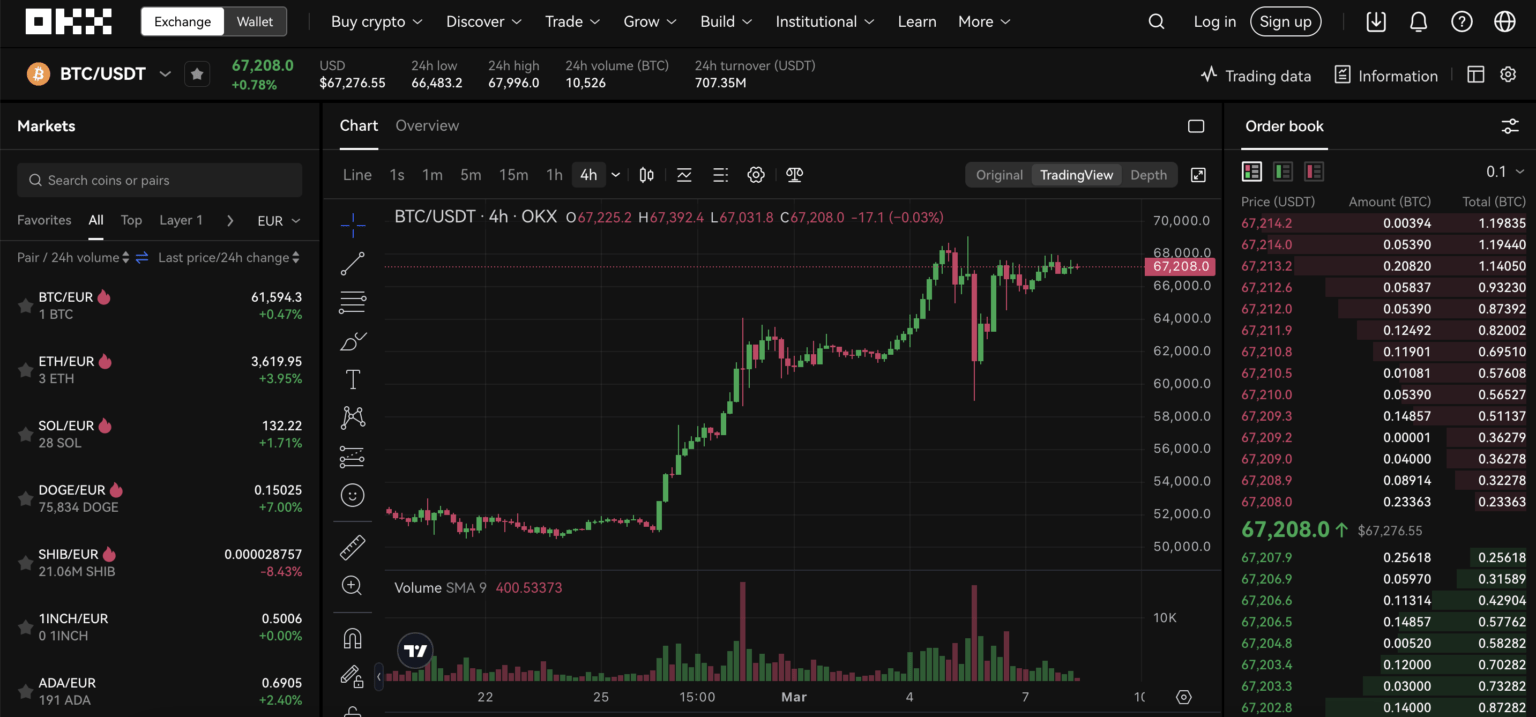
For everyday spot trading, OKX behaves like other major CEXs: TradingView-style charts, market and limit orders, and a deep order book for major pairs. Where traders often misjudge the platform is in margin and derivatives: isolated and cross-margin modes let you magnify positions up to 10x on margin and up to 125x on some perpetuals and futures. High leverage dramatically shortens the time to liquidation; small adverse moves plus slippage can wipe collateral quickly. Practically, that means US traders should match leverage to liquidity: use lower leverage on large-cap pairs with tight spreads and avoid maximum leverage on low-volume tokens with wide bid-ask spreads.
Execution risks are also structural. High-frequency price moves create slippage: market orders during rapid moves can fill far from expected prices. On low-liquidity chains or assets, even limit orders may be exposed to front-running and sandwich attacks when routed through DEX bridges. OKX mitigates some of these by aggregating liquidity and offering advanced order types, but the core trade-off remains: speed and leverage versus execution certainty.
Login, verification, and practical login steps
Account protection on OKX layers military-grade encryption, AI-driven monitoring for suspicious login behavior, and mandatory Two-Factor Authentication (2FA) through SMS, Google Authenticator, or biometrics on mobile apps. For US-based users, Identity Verification (KYC) is a legal necessity: opening an account requires a government ID and a facial liveness check. That KYC gate both reduces anonymous abuse and creates an operational dependency — losing access to your account or failing a liveness check can complicate recovery.
If your goal is simply to access the platform, the friction points are predictable and manageable. Start with a strong, unique password; enable 2FA and biometrics where available; link a hardware wallet if you use the non-custodial features; and verify identity early so you avoid limits during deposit or withdrawal. For a quick entry point, follow an official login path and double-check the URL. (If you need a straightforward starting link, this page explains the standard web login process: okx login.)
Where OKX helps and where it doesn’t — a trade-off map
What OKX is good at:
– Liquidity for major pairs and advanced order types for traders who depend on speed.
– A wide asset list (300+ tokens) and multi-chain support (130+ blockchains) that reduce the need to hop between platforms.
– Institutional-grade custody and PoR, which together increase transparency and lower certain counterparty risks.
What OKX cannot remove:
– Market risk: volatility and slippage remain the dominant risk for traders, especially with leverage.
– External security risks: phishing attacks, social-engineering, or compromise of personal devices can nullify platform protections.
– Smart contract risk: the Web3 wallet, DeFi yield farms, and the DEX aggregator expose users to the same contract vulnerabilities and economic exploits that affect all DeFi activity.
Decision-useful heuristics for US traders
Here are three practical heuristics to apply before you trade on OKX:
1) Match leverage to liquidity: limit leverage to 2–5x on medium-volume altcoins; reserve 10x+ only for top-cap pairs with deep books.
2) Separate roles: use the custodial account on OKX for active trading and rehouse long-term holdings into a self-custodial wallet or hardware wallet for long-term storage and staking.
3) Make verification proactive: complete KYC and link 2FA before you need a fast withdrawal — regulatory and operational delays are the common snag during stressed markets.
These heuristics convert platform features into risk-managed behavior. They reflect an orientation toward preserving optionality (easy exit) while still capturing the execution benefits of a major CEX.
What to watch next (signals, not guarantees)
Watch for these conditional signals rather than take them as forecasts: broader adoption of PoR-like transparency will pressure other exchanges to provide verifiable reserves; changes in US regulatory guidance could alter KYC friction or the availability of certain derivatives to US residents; and technical innovations in cross-chain bridges may reduce the execution cost of moving assets between chains, changing the calculus between CEX custody and self-custody. Any one of these changes would modify the trade-offs described above, but none would eliminate fundamentally hard problems like market volatility and social-engineering risk.
FAQ
Do I need KYC to trade on OKX from the US?
Yes. To comply with AML rules, OKX requires identity verification: upload a government-issued ID and complete a facial liveness check. KYC typically unlocks higher deposit and withdrawal limits and access to derivatives. Preparing documents in advance avoids delays during high-volatility periods.
Is Proof of Reserves the same as proof of solvency?
Not exactly. Proof of Reserves shows that the exchange holds on-chain assets corresponding to user liabilities at the snapshot time and for the addresses published. It increases transparency and reduces some counterparty risk, but it is not a perpetual guarantee against operational failures, temporary freezes, or mis-accounting between snapshots.
What’s the best way to secure my login and avoid phishing?
Use a password manager for unique passwords, enable 2FA (prefer authenticator apps or hardware keys over SMS), verify the site URL before entering credentials, and consider a dedicated browser profile or hardware wallet for Web3 interactions. AI-driven protective systems on the exchange help, but they are not a substitute for personal operational security.
Should I use OKX staking and yield products?
Staking and yield farming can be sensible for excess balances you do not need for margin collateral. The trade-off is liquidity and counterparty exposure: fixed-term staking locks funds; DeFi farming brings smart contract risk. If you stake on-custodial with OKX, you trade some control for operational convenience; if you use the non-custodial wallet, you keep control at the cost of personal key-management responsibility.
Closing: a reframed takeaway
OKX offers a rich set of tools that can accelerate trading strategies, but those tools change the shape of risk rather than eliminate it. Treat PoR and cold-storage claims as improved information and safer infrastructure, not as substitutes for careful position sizing, account hygiene, and a plan for emergencies. For US traders the pragmatic path is clear: use OKX for execution and liquidity, complete verification and 2FA before markets move, and combine platform convenience with self-custody for long-term holdings. That mix preserves both optionality and speed — the two qualities that matter most when markets tighten.