That instinct — to treat the exchange as a single, safe place for everything — is natural. After all, OKX packages a full ecosystem: centralized exchange (CEX) services, a non‑custodial Web3 wallet, an NFT marketplace, DeFi access, and advanced charting, all under one roof. But mixing custody models, login methods, and high‑leverage trading without a clear operational framework increases exposure in ways many traders don’t appreciate. This article unpacks how OKX’s wallet and trading stack work, what specific attack surfaces and operational trade‑offs matter for US traders, and how to build a predictable, risk‑controlled workflow for logging in and trading.
Read this as a decision manual more than a feature listing. I’ll correct a couple of common misconceptions, show the mechanism-level reasons they’re misleading, and give practical heuristics you can use when you log in, custody assets, or move between the on‑exchange and Web3 worlds.
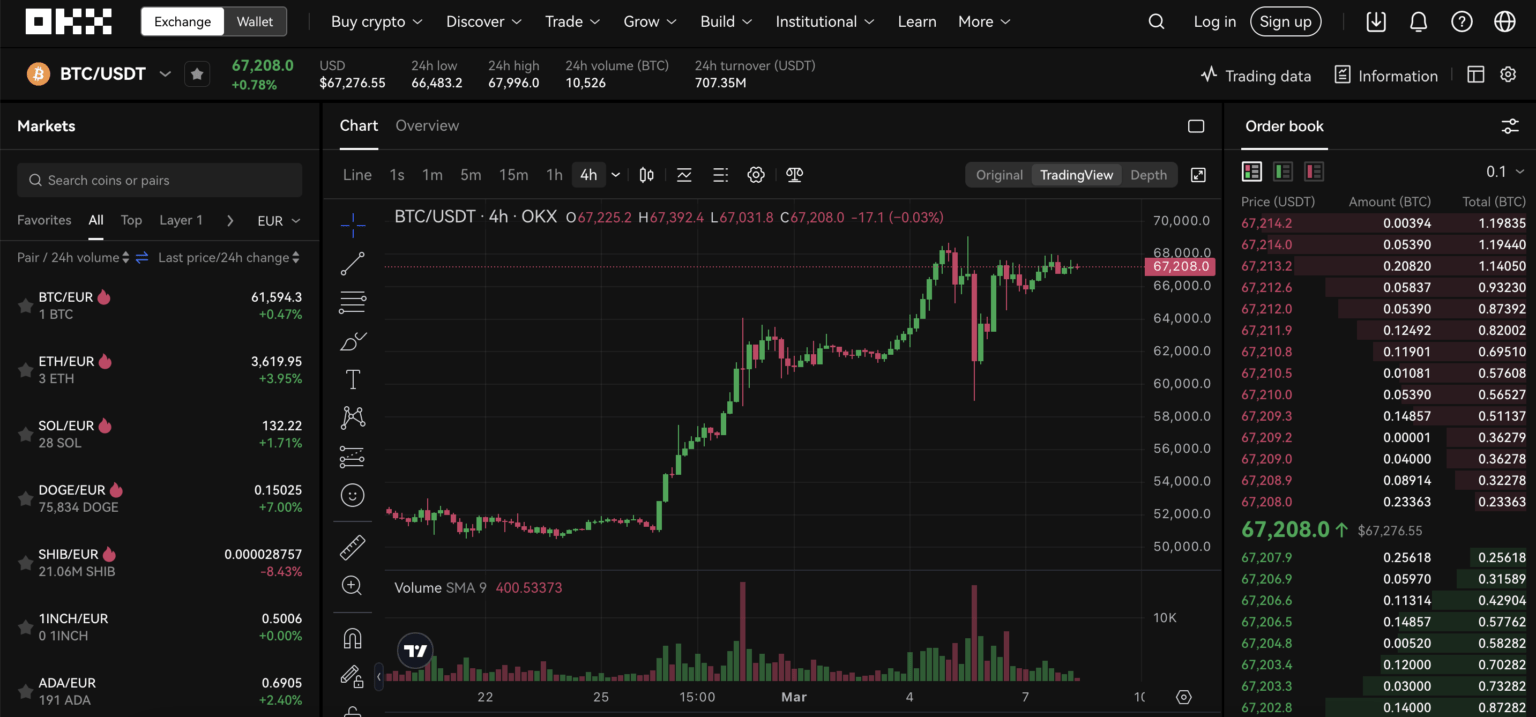
Misconception and correction: centralization equals safety; self‑custody equals responsibility
Many traders assume that leaving assets on OKX is safer than self‑custody because the exchange uses cold storage and multi‑sig. That is true in a narrow sense: OKX reports keeping over 95% of assets in air‑gapped cold wallets with multi‑signature withdrawal controls, and it publishes Proof of Reserves to increase on‑chain transparency. Those are meaningful protections against large‑scale platform theft.
But “safer” is contextual. Keeping assets on a CEX trades counterparty risk, KYC exposure, and potential withdrawal controls for the convenience of custody, liquidity, and fast execution. Self‑custody (OKX’s non‑custodial Web3 wallet) removes the counterparty but places absolute responsibility on the user: lose the seed phrase and there is no recovery. The best practice for serious US traders is not “pick one” but “design roles” — decide which assets need exchange convenience versus which should be held off‑exchange for long‑term security or DeFi interaction.
How OKX’s login and account protections actually work — and where attackers aim
Mechanics first: OKX secures accounts with a combination of KYC, mandatory two‑factor authentication (2FA), military‑grade encryption, and AI‑driven login monitoring for suspicious activity. For traders in the US this also means identity verification (government ID + facial liveness checks) is required to unlock fiat on‑ramps and most account functions. Biometric logins are available on mobile apps, and the platform supports hardware wallets for the Web3 wallet.
That sounds comprehensive; attackers respond by shifting to human‑facing vectors. Phishing remains the single most common vector: credential‑harvesting sites, fake apps, manipulated browser extensions, and SIM swap attacks to bypass SMS 2FA. Another vector is social engineering aimed at convincing a user to move funds to an attacker‑controlled address under the pretense of “verification” or “support.” OKX’s AI monitors unusual logins, but those alerts are reactive and can be delayed in edge cases. So guardrails matter on the user side: strong 2FA, hardware keys for sensitive operations, and disciplined transfer rules.
Trading modes, margin, and leverage: mechanism, margin calls, and real cost
OKX supports spot trading, margin (up to 10x), futures, options, and perpetual swaps (leverage up to 125x on some instruments). Mechanically, margin amplifies both gains and losses: you borrow collateral to increase position size, and liquidations occur when maintenance margin thresholds are breached. Perpetual swaps include funding rates that can penalize one side of the market over time.
Two practical implications for logins and account setup: 1) Leverage amplifies operational mistakes — a single compromised login combined with a leveraged position can wipe an account far faster than a spot loss. 2) Faster execution matters for risk management. If you rely on mobile biometric login, ensure it’s tied to hardware 2FA or Google Authenticator for withdrawal and margin permissions, because SMS alone is vulnerable to SIM swap.
Crossing CEX and Web3: interoperability, DEX aggregation, and the attack surface
OKX’s Web3 wallet and DEX aggregator enable cross‑chain swaps across 130+ blockchains and pull liquidity from major DEXs to optimize routes. That convenience comes with layered risks. When you move assets from the exchange to the non‑custodial wallet to interact with a DeFi protocol, you expose yourself to smart contract risk and to additional phishing surfaces (malicious dApps asking to approve token allowances, for instance).
A useful mental model: think of custody boundary transitions as “context switches.” Each switch — CEX -> Web3 wallet, wallet -> dApp, wallet -> hardware wallet — is an event that increases the probability of operational error or compromise. Reduce switches where possible, and when you must switch, follow a checklist: confirm domain, verify contract addresses on a secondary device, use hardware wallet signing, and limit token allowances (use ‘exact amount’ approvals rather than unlimited allowances).
Operational framework: four rules for US traders logging into OKX and moving funds
Rule 1 — Segregate roles. Keep a trading balance on‑exchange sized for your active strategies; store long‑term holdings in self‑custody or hardware wallets. Rule 2 — Harden the login: prefer app + authenticator or hardware keys; treat SMS as a fallback. Rule 3 — Make a transfer game plan: if you’re withdrawing to interact with DeFi, use small test transfers and limited approvals. Rule 4 — Document and rehearse recovery: record where seed phrases and hardware wallets are stored (offline), and practice account recovery steps so panic doesn’t lead to mistakes during market moves.
These are simple rules, but they force tradeoffs: liquidity vs. control, convenience vs. recoverability. Your acceptable balance depends on your time horizon, tax/liability appetite in the US regulatory context, and how much automation or bots you use for execution.
Where the system could break — limitations and unresolved tensions
No system is bulletproof. OKX’s cold storage and PoR reduce the risk of aggregate insolvency, but PoR is a snapshot and does not prevent catastrophic events like coordinated phishing campaigns that drain hot wallets or regulatory actions that temporarily freeze accounts. Decentralized features (wallets, DEX aggregator) expose users to smart contract bugs and composability risk: a seemingly harmless token can carry a backdoor or interact unpredictably across bridges.
There is also a policy boundary: KYC and facial liveness checks protect fiat corridors but create an identifiable on‑chain footprint linking identity to crypto balances. For some traders this is acceptable and necessary; for others it is a privacy cost that must be managed through non‑custodial solutions and careful on‑chain hygiene.
If you want a single, action‑oriented link that helps with the practical step of signing in and understanding platform navigation during an active session, you can find a concise login guide here.
Decision heuristics: quick checklists before you click “login” or “withdraw”
Before logging in: confirm the URL or app source, update the app, use a private network (avoid public Wi‑Fi), and ensure 2FA device is available. Before withdrawing: confirm the destination address twice on a different device, send a micro‑transaction first, and review approval scopes in your wallet. Before opening leveraged positions: verify margin settings (isolated vs cross), set stop losses with hard limits, and ensure the account’s liquidation thresholds are understood for the traded instrument.
These are small frictions that prevent catastrophic outcomes.
What to watch next — conditional scenarios and signals
Watch three signals that would change how you use OKX: changes in KYC or custody policy that broaden freezing powers; material updates to PoR methodology (moving from snapshots to continuous proofs); and major smart contract incidents in the OKX Web3 stack or DEX aggregator. Any of these would shift the optimal balance between on‑exchange liquidity and off‑exchange custody for US traders.
Another near‑term trend to monitor is regulatory clarity in the US. If rules tighten around derivatives or stablecoin on‑ramps, expect product availability for US accounts to shift; that will alter the cost of keeping assets on the exchange versus moving them to self‑custody.
FAQ
Do I need to verify my identity to trade on OKX from the US?
Yes. To use fiat on‑ramps and many exchange functions in compliance with AML rules, OKX requires KYC — government ID plus a facial liveness check. You can still use some Web3 wallet features without KYC, but account capabilities will be limited.
Is it safer to keep crypto on OKX or in the OKX Web3 wallet?
“Safer” depends on the threat you fear. Exchange custody reduces personal key management risk and provides institutional protections like cold storage, but it introduces counterparty and regulatory risks. The Web3 wallet gives you cryptographic control but places full responsibility on you for recovery and smart contract diligence.
Which 2FA should I choose?
Prefer an authenticator app (Google Authenticator or similar) or hardware security key for withdrawals and security‑sensitive operations. Treat SMS as a fallback only; it’s vulnerable to SIM swap in the US market.
Can OKX’s Proof of Reserves be used to guarantee my deposits?
PoR increases transparency by showing on‑chain backing snapshots, but it’s not a legal guarantee. It’s a useful signal about solvency, not an insurance policy against operational or policy risks. Treat PoR as one data point among many.