What happens when you treat an exchange like a bank account and a wallet like a high-security safe? The routine assumption—that custody and trading are the same operational problem—drives a lot of mistakes. This piece unpacks how OKX’s futures, spot trading, and wallet features actually work, what they protect you from, what they do not, and the concrete operational choices a U.S. retail trader should make before logging in and putting size on the line.
The goal is not marketing cheerleading. It is to clear three common confusions: that Proof of Reserves equals costless safety; that high leverage is just a way to turbocharge gains without new risks; and that a Web3 wallet integrated with an exchange makes custody trivial. I’ll explain mechanisms, spell trade-offs, and leave you with decision rules you can act on tonight.
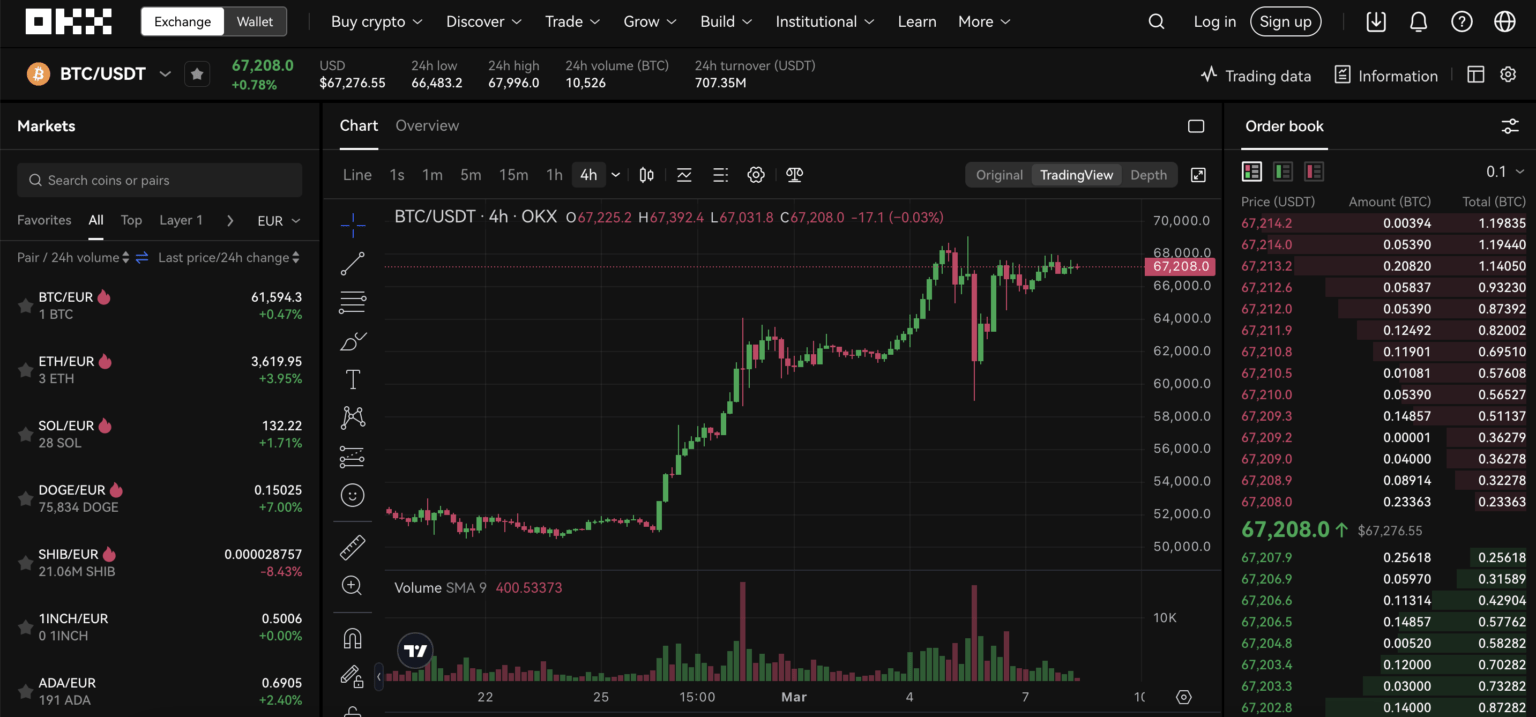
How OKX stitches together spot, futures, and wallet functions — the mechanisms that matter
Mechanically, OKX is a hybrid platform: a centralized exchange (CEX) for spot and derivatives, plus a non-custodial Web3 wallet and an NFT/DeFi hub. That combination is powerful but brings an architectural reality: different security properties apply depending on which subsystem you use.
Spot trading: your deposited assets on the exchange are custodial. OKX publishes Proof of Reserves (PoR) on-chain, which lets third parties verify that on aggregate the exchange holds assets that correspond to user balances. PoR is a transparency tool — it reduces certain classes of insolvency risk by creating public evidence that the pools exist — but it is not a substitute for operational security or insurance against fraud. PoR says “the assets exist,” not “you can withdraw instantly without limits” or “there are no off-ledger liabilities.”
Futures and derivatives: OKX supports perpetual swaps, quarterly futures, and options with leverage up to 125x on some pairs. Mechanically, futures are margined positions where the platform posts and collects collateral and variation margin, often executed by an automated risk engine. Higher leverage compresses the price movement needed to liquidate a position; at 125x, a small adverse move plus slippage or delayed margin calls makes liquidation almost inevitable for inexperienced traders. OKX also offers up to 10x leverage on margin for spot-like borrowing—these are distinct margin flows from the derivatives engine.
Wallet: OKX has two custody models. Custodial balances on the CEX sit in OKX-controlled wallets (where cold-storage solutions and multisig processes are the principal defenses). The platform reports holding over 95% of user funds in air-gapped cold wallets with multi-signature withdrawal controls. Separately, OKX provides a non-custodial Web3 wallet where you hold your seed phrase and integrate hardware wallets like Ledger and Trezor. That wallet interacts with DEXs and DApps via a browser extension and mobile app.
Common misconceptions and the corrected view — myth-busting in practice
Myth 1: “Proof of Reserves means my money is perfectly safe.” Correction: PoR improves transparency but is not a guarantee of ongoing operational resilience. It validates balances at snapshot times and makes certain malfeasance harder to hide. However, it does not eliminate counterparty risk from business decisions, nor does it prevent social-engineering attacks that drain user accounts. Treat PoR as valuable evidence, not a security promise.
Myth 2: “High leverage is a shortcut to outsized returns if you have a strong conviction.” Correction: leverage amplifies both P&L and operational risk. The bootstrap mechanics—liquidation engines, funding rate volatility, and slippage during stressed markets—mean that leverage increases the probability of sudden, severe losses. For U.S. retail traders, a simple heuristic is: if you cannot tolerate a margin call that could close your position in minutes, reduce leverage or size.
Myth 3: “Using a Web3 wallet inside the OKX ecosystem eliminates private-key risk.” Correction: the non-custodial wallet gives you control — which is both a feature and a responsibility. If you lose the seed phrase, that loss is usually permanent. If you connect the wallet to a malicious DApp or fall victim to a phishing wallet prompt, funds can leave your address immediately. The wallet reduces exchange-counterparty risk but increases your operational custody responsibilities.
Security trade-offs and practical decision rules for U.S. traders
There are three linked dimensions to protect: account access, exchange custody, and self-custody. Each requires different controls.
Account access: OKX emphasizes strong login protections — military-grade encryption, AI-driven anomaly detection, and mandatory two-factor authentication (2FA) via SMS, Google Authenticator, or biometrics. For U.S. users, prefer an authenticator app or hardware 2FA over SMS where possible, because SIM-swap attacks remain a live threat. Use device-specific biometric login only as a convenience layer on trusted personal devices, not as a sole authentication method.
Exchange custody: the platform’s cold-storage and multisig practices materially reduce large-scale theft risk. But withdrawal controls and risk management are still operational: exchanges can impose withdrawal holds, limits, or temporary freezes during incidents. If you need guaranteed, immediate on-chain access to assets, custodial exchange balances are not equivalent to self-custody. A practical split is to keep trading capital on the exchange (what you actively use) and move medium-to-long-term holdings to a self-custodial wallet or hardware device.
Self-custody: for long-term holdings or large sums, prefer a hardware wallet (Ledger/Trezor) integrated with the OKX non-custodial wallet or used separately. Document and redundantly store seed phrases in fire-safe formats. Consider using multi-signature setups for very large amounts—single-seed storage is a single point of failure.
How spot and futures interact operationally — hedging, funding, and cross-margin risk
One operational misconception is that spot and futures are isolated as risk domains. In practice, balance and margin flows move capital between these domains via internal transfers. If you run a spot position hedged by futures, margin calls on the futures side can force unintended spot liquidations if your account uses cross-margin. Isolate risk by using isolated margin for high-leverage futures trades and reserve a safety buffer in a separate account or wallet to meet variation margin requirements.
Funding rates and basis: perpetual swaps use funding payments to tether contract prices to spot. When funding is persistently positive or negative, it signals directional market pressure — but it also represents an ongoing cash flow you must manage if you hold a perpetual position. Short-term traders should model expected funding costs into their P&L; longer-term hedgers should use quarterly futures to avoid continuous funding exposure at the cost of roll risk.
Practical checklist before you click “login” and trade
1) Verify your device and browser are clean: updated OS, no unknown extensions, and a hardware 2FA key if available. 2) Use a dedicated email with strong, unique password and an authenticator app (not SMS) for 2FA. 3) Decide custody split: amount on-exchange for trading vs amount off-exchange in a hardware or non-custodial wallet. 4) If trading futures, size positions to allow at least two realistic stress scenarios (fast move, slow move with funding spikes). 5) Bookmark only the official login link and access OKX directly — avoid links from DMs or unverified sources. For an authorized start point, use this official guidance when you need to sign in: okx login.
Limits, unresolved questions, and what to watch next
Limitations matter. PoR remains a snapshot tool; it cannot, by itself, confirm liquidity under extreme withdrawal demand. The non-custodial wallet’s security depends entirely on user competence in key management. Regulatory uncertainty in the U.S. could change product availability, leverage caps, or KYC procedures; OKX’s current KYC involves ID and facial liveness checks, but enforcement and operational details can evolve with policy. Finally, interoperability (130+ blockchains) is beneficial but increases attack surface: cross-chain bridges and aggregators are often targets for exploits.
Signals to monitor in the near term: changes to leverage caps or product availability in U.S. jurisdictions, updates to PoR frequency or methodology, and any platform incident reports that reveal gaps in withdrawal processes or multisig governance. Those signals should materially influence how much capital you keep on the platform.
Decision-useful heuristics: three rules for disciplined traders
Rule 1 — “Only keep the working set on the exchange”: define and transfer off-exchange anything you won’t actively trade for weeks. Rule 2 — “Size by liquidation distance”: calculate how many ticks are needed to wipe your margin at current volatility; if that distance is less than three times typical intraday swings, reduce size or leverage. Rule 3 — “Think in layers, not absolutes”: combine custodial and non-custodial storage, hardware keys for permissions, and written operational playbooks for incident response (how to move funds, contact support, and escalate).
FAQ — practical answers to common questions
Does OKX’s Proof of Reserves mean I don’t need to worry about counterparty risk?
No. Proof of Reserves provides on-chain evidence of assets at given times and improves transparency, but it does not eliminate counterparty risk from business operations, potential off-ledger liabilities, or governance failures. Use PoR as one input among many: custody practices, insurance policy terms (if any), and operational history.
Should I use OKX’s non-custodial wallet or keep funds on the exchange?
It depends on your goal. Use the custodial exchange for active trading and margin/derivatives exposure where speed and capital efficiency matter. Move medium- to long-term holdings to a non-custodial or hardware wallet to reduce counterparty risk. If you choose non-custodial, accept the responsibility of secure seed storage and careful DApp permissions.
How risky is trading OKX futures with high leverage?
High leverage increases both upside and the probability of rapid, total losses. Risks include liquidation mechanics, funding rate spikes, and slippage in stressed markets. For most U.S. retail traders, conservative leverage and clear stop-loss discipline are advisable.
What are the most common attack surfaces to protect against?
Phishing sites and cloned browser extensions, SIM-swap and SMS-based 2FA attacks, malicious DApp approvals when using a Web3 wallet, and poor seed-phrase storage are frequent culprits. Use app-based or hardware 2FA, validate domain names, and restrict DApp approvals to necessary permissions.
Final practical take: OKX’s technical and operational controls are robust in many respects — PoR, cold storage, multi-sig, KYC, and account protections reduce several systemic risks. But no single platform can remove the fundamental trade-offs between custody and convenience, or between leverage and survivability. Treat the platform as a set of tools: use the exchange for what it does well (liquidity, derivatives, capital efficiency) and the wallet for what you as a user must control (private keys, long-term custody). That disciplined separation, paired with simple operational rules, is the difference between a well-run trading account and one that becomes a costly lesson.