Many traders assume that logging into a reputable exchange is the end of their security story: create an account, verify identity once, and trade. That’s a useful starting point but incomplete. OKX packages a centralized exchange, a non‑custodial Web3 wallet, an NFT marketplace, and a DeFi hub under one roof. Each of those components changes which attack surfaces matter and which operational trade‑offs you must manage as a U.S. trader, especially when you add futures and high‑leverage derivatives into the picture.
This article walks a U.S.-based crypto trader through a concrete, case‑led scenario: logging into OKX, enabling futures trading, and deciding how—or whether—to use the Web3 wallet and DeFi features. The goal: give you a reusable mental model to compare custody choices, authentication paths, and risk controls so your next login is also a disciplined security decision, not a ritual.
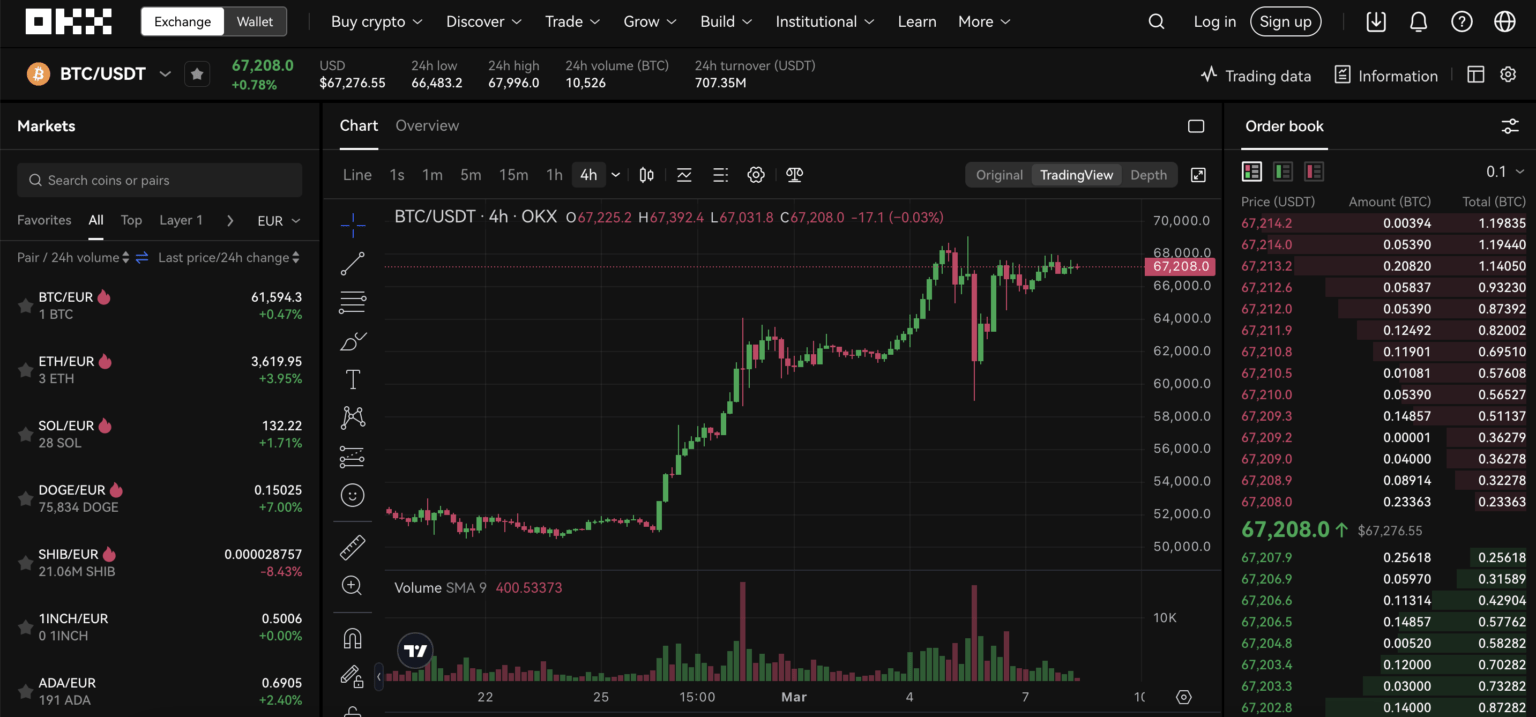
Case scenario: a U.S. trader preparing to use OKX futures
Imagine you’re a trader in New York who wants exposure to BTC via perpetual swaps with 50x leverage while occasionally minting NFTs and trying a DeFi yield farm. You sign up and hit the two familiar friction points: identity verification (KYC) and account hardening (2FA). In OKX’s flow, KYC requires a government ID and a facial liveness check; logins are protected by mandatory two‑factor authentication and AI monitoring for suspicious sessions. All good. But beneath those checks are multiple policy and technical seams you must negotiate.
First seam: custody split. On OKX, assets you leave on the exchange are held custodially—protected by multi‑sig, air‑gapped cold storage for over 95% of holdings and on‑chain Proof of Reserves. That reduces counterparty risk compared with a smaller, uninsured venue. But it doesn’t eliminate user-side risk: phishing, SIM‑swap attacks affecting SMS 2FA, and social‑engineering that targets account recovery can still cause loss. Second seam: the Web3 wallet is non‑custodial. If you move funds into the Web3 wallet, you control the seed phrase; losing it is permanent. The two models coexist in the same UI, and moving funds between them mixes vulnerabilities unless you follow a disciplined workflow.
How OKX futures work and why security posture matters
Mechanically, futures and perpetual swaps let you control a notional exposure larger than your margin using leverage—OKX offers up to 125x on some products, and more commonly up to 10x for margin modes. That magnifies both gains and losses and imposes operational constraints: forced liquidations can happen during sudden volatility; margin calls may require rapid transfers; and high leverage increases the importance of exact position sizing. For our trader, the key point is this: speed and precision matter. Any account outage or delayed login during a volatile move can create outsized losses.
Operationally, that argues for splitting responsibilities. Keep active trading capital on the custodial exchange wallet for faster order execution and margin management; keep long‑term holdings or experimental DeFi capital in the non‑custodial Web3 wallet. But don’t assume transfers are frictionless: cross‑chain swaps, network congestion, and DEX slippage can delay or distort fund flows when you need to top up a margin account. That’s a trade‑off between control and convenience.
Verification, account recovery, and the U.S. regulatory reality
OKX’s KYC is not an optional speed bump in the U.S.—it’s part of legal compliance. Expect identity checks and a facial liveness step. That improves AML compliance and reduces some types of illicit account opening, but it also introduces privacy and resilience trade‑offs: if an attacker compromises your identity documents or lures you into a fake “support” flow, they might attempt account recovery impersonation. The positive side is that many recovery attacks are harder when exchanges enforce strict KYC plus multi‑factor checks; the negative side is that you still rely on the exchange’s operational security and customer service rigor.
Practically, preserve copies of the exact email, phone, and recovery methods you used during KYC, and prefer app‑based 2FA or hardware security keys over SMS when available. OKX supports biometric logins on mobile and common 2FA apps; those reduce attack surface compared to SIM‑swapable SMS codes. But biometrics add device‑lock dependencies: if your phone dies or you factory‑reset it without a backup, you could face friction proving identity to the exchange.
Where the platform helps and where human discipline still wins
OKX brings structural defenses: Proof of Reserves for transparency, air‑gapped cold storage to mitigate exchange hacks, and AI‑driven anomaly detection to slow unusual logins. The platform also bundles an NFT marketplace and a DEX aggregator, which offers convenience when bridging assets or exploring yield. However, platform-level protections are not a substitute for user discipline. Even with PoR, a compromised account can lose assets through authorized withdrawals; with a Web3 wallet, a lost seed phrase is final. The operating rule is simple: match the tool to the objective and threat model.
A practical heuristic: classify funds into three buckets—(1) trading balance for futures (keep on the exchange, limited exposure), (2) medium‑term holdings and staking (hot but diversified across custody/lockups), and (3) long‑term cold custody (hardware wallet or external cold storage). Move funds deliberately, not routinely. Automate alerts for margin thresholds, and maintain an emergency plan to offload risk if needed. These practices are mundane but often decisive under stress.
One non‑obvious risk: interface ambiguity between CEX and Web3 components
Because OKX offers both custodial and non‑custodial experiences inside one interface, users can mistake the default wallet context. You might think “wallet” means your exchange balance; it could instead mean your non‑custodial seed‑controlled wallet. That confusion has led to mistaken transfers in multi‑platform products elsewhere, and the same ambiguity is a realistic hazard here. Before signing or approving any transaction, verify the address, the fee, the network, and whether the action is on‑chain or an off‑exchange transfer.
Another subtle point: interacting with DeFi protocols exposes you to smart‑contract risk and possible rug pulls. If you authorize a contract with your Web3 wallet, an approval could permit drainage of tokens later. Limit approvals, use spend limits, and, where possible, route large or unfamiliar contracts through hardware wallets or wallets with transaction‑signing review screens.
Decision‑useful checklist for logging in and trading futures on OKX (U.S. trader)
1) Before first login: prepare KYC documents, set up a dedicated email, and choose an authenticator app or hardware security key—avoid SMS. 2) Account setup: enable 2FA, register withdrawal whitelist addresses, and enable login alerts. 3) Fund allocation: keep only the active margin you need on the CEX; larger holdings should use cold custody or the non‑custodial wallet with hardware integration. 4) Transfer practice: practice small test transfers when moving funds between custodial and non‑custodial wallets or across chains. 5) Trade sizing: use position-sizing rules that account for worst‑case slippage and potential transfer delays. 6) Emergency playbook: document how you’ll respond to a suspected compromise (freeze API keys, contact support through verified channels, move non‑custodial funds to cold storage).
If you need a starting place to access OKX from a desktop or mobile browser, here’s the exchange’s official login path: okx login.
What to watch next (signals, not predictions)
Watch three signals rather than pronouncing outcomes. First, product governance around wallet UX: clearer separation of custodial vs. non‑custodial contexts in the UI reduces user error. Second, regulatory changes in the U.S. around KYC and derivatives—they could alter onboarding friction or product availability for U.S. users. Third, risk‑management features—native withdrawal whitelists, hardware‑key integration, and programmable spend limits—will materially change how safe heavy futures traders can operate. Each of these is a conditional signal: stronger UX + hardware support reduces user error; tighter regulations increase verification friction but may lower fraud risk.
FAQ
Q: If I enable futures on OKX, should I keep all my funds on the exchange?
A: No. Keep only the capital you need for active positions on the exchange. Larger or long‑term holdings are better in cold custody or your non‑custodial Web3 wallet. The exchange is optimized for liquidity and speed; long‑term storage is optimized for security and limited accessibility. Balancing those objectives is essential when trading leveraged products.
Q: Is OKX’s Proof of Reserves a guarantee I can withdraw anytime?
A: Proof of Reserves improves transparency by showing on‑chain backing for assets, but it is not an operational guarantee against temporary withdrawal freezes or compliance holds. PoR reduces certain solvency concerns but doesn’t remove all counterparty or operational risks; you still need to manage access and authentication aggressively.
Q: Which 2FA method is best for U.S. users on OKX?
A: App‑based authenticators (like Google Authenticator or hardware security keys) are generally better than SMS because they resist SIM‑swap attacks. Biometric logins add convenience on mobile but introduce device recovery challenges. Use a hardware security key for the highest practical protection on desktop.
Q: How risky is using OKX’s Web3 wallet with DeFi apps?
A: It’s functionally different risk. Web3 wallets give you control (and sole responsibility) for your seed phrase. Smart contracts have bugs or economic exploits; approvals can be abused. Treat Web3 interactions as independent from exchange security—use minimal approvals, hardware confirmation, and small test transactions to reduce exposure.