Surprising stat to start: exchanges that publish verifiable proofs of reserves halve a common source of trust-related panic among professional traders — not by eliminating risk, but by changing what questions traders must ask. For a U.S.-based trader deciding whether to log in, fund, or shift positions to OKX, the core decision is not simply “is OKX safe?” but “which risks am I accepting, which controls do I still own, and how does OKX’s architecture change my operating model?”
This piece uses a single, realistic case — an experienced U.S. derivatives trader reopening a dormant account to trade OKX perpetual futures while also experimenting with the OKX Web3 wallet — to unpack the how, why, limits, and trade-offs. I translate platform-level facts (proof of reserves, KYC, 2FA, cold storage, futures leverage) into decision rules you can apply immediately, and I mark the boundary where centralized convenience meets self-custody responsibility.
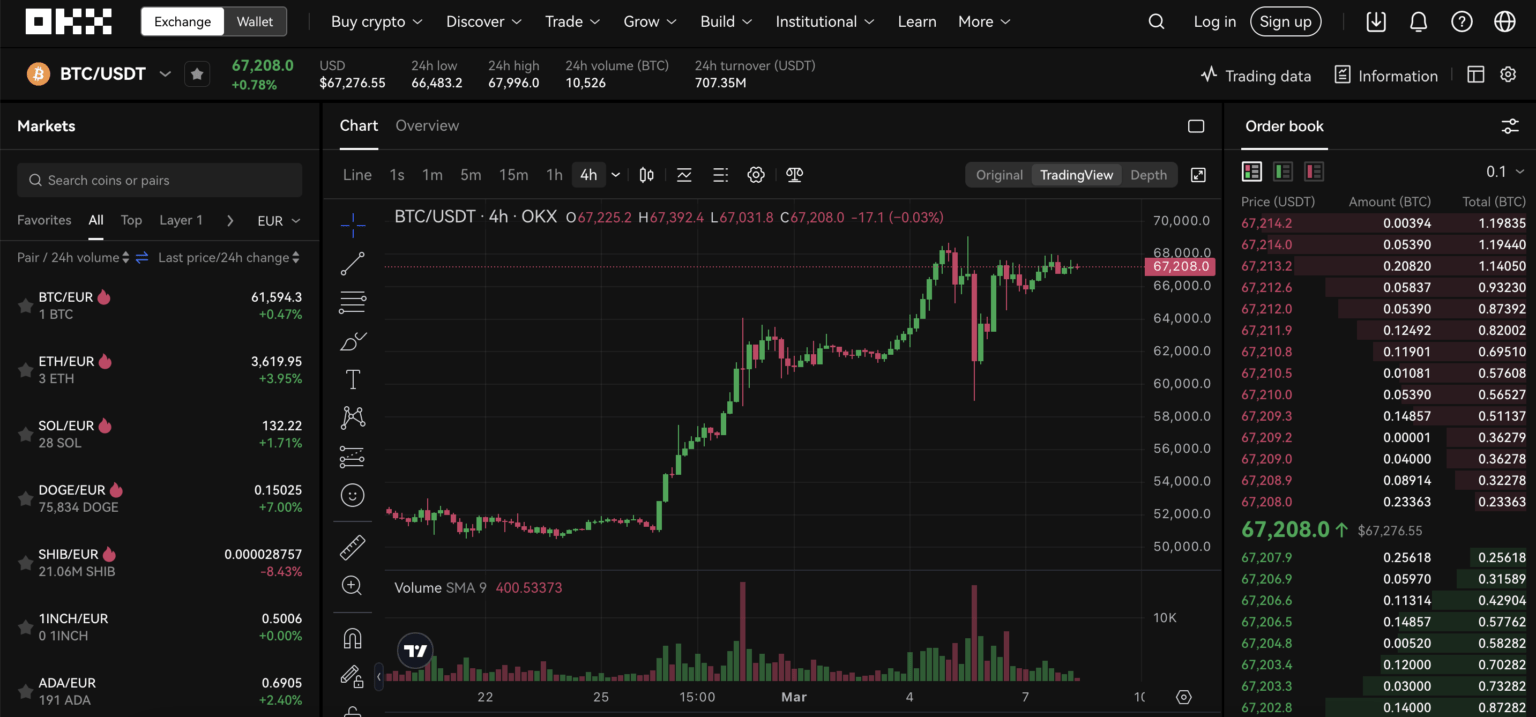
Case profile: reactivating an account to trade OKX futures and try Web3
Imagine you — a U.S. retail trader familiar with spot markets and basic margin — want to reopen an OKX account to trade perpetual swaps up to 125x on certain assets, while also moving a small allocation into an OKX non-custodial Web3 wallet to test DeFi yield strategies. Key starting constraints: U.S. regulatory environment means KYC is mandatory, you must pass facial liveness checks, and you expect robust login security (2FA and AI-driven threat detection).
Mechanically, the reactivation pathway will require identity verification (upload ID, complete the liveness check) and enable platform protections. Practically, that matters because KYC unlocks derivatives access, deposit/withdrawal limits, and regulatory traceability — three things that change how you manage counterparty and legal risk. KYC does not reduce market risk; it changes operational and compliance risk profiles.
How Verification and Account Protections Work — mechanisms you should understand
OKX’s verification is not just about identity; it’s an access-control gate. Mechanisms involved: a government ID check, automated document verification, a face-based liveness check, and then mapping that identity to on-chain and custody operations. For logins, mandatory 2FA (SMS, Google Authenticator, or biometrics on mobile) combines with military-grade encryption and AI-driven monitoring that can flag suspicious IPs, device changes, or atypical withdrawal patterns in real time.
Why this matters: for leveraged products such as futures and perpetual swaps the platform’s account protections directly influence liquidation pathways. If the platform detects a high-risk session and enforces additional verification steps or temporarily suspends withdrawals, that can complicate an already fast-moving margin call. In short: strong login protections reduce theft risk but can add latency during emergency exits — a trade-off worth planning for.
Proof of Reserves — what it is and what it isn’t
OKX provides Proof of Reserves (PoR) on-chain, which lets third parties verify that the exchange holds on-chain assets at least equal to user balances at snapshot times. Mechanism: a Merkle-tree or similar cryptographic attestation links aggregate liabilities to on-chain holdings so auditors or users can check balances without revealing sensitive account-level data.
Important limits: PoR demonstrates solvency at specific snapshots and for on-chain assets, but it does not prove continuous operational liquidity, nor does it guarantee that off-chain obligations or certain derivatives exposures are fully collateralized at every moment. Treat PoR as a transparency signal, not an ironclad insurance policy.
Trading Futures on OKX: mechanics, leverage, and failure modes
Futures and perpetuals are attractive because they let you express directional views with capital efficiency. On OKX you can access perpetuals and quarterly futures with leverage up to 125x on selected assets. Mechanically, higher leverage amplifies margin requirements, reduces the time-to-liquidation, and increases sensitivity to slippage and funding-rate costs.
Two practical trade-offs matter to U.S. traders: first, higher leverage reduces capital efficiency only in a good way when you manage risk tightly; in adverse moves it accelerates realized losses and can trigger socialized loss mechanisms or auto-deleveraging in extreme conditions. Second, liquidity varies by contract: top BTC/ETH perpetuals are deep, but altcoin perpetuals can have wide spreads and shallow book depth, producing painful slippage on liquidation events.
Operational heuristics: cap leverage to a level you can monitor intraday; place staggered stop-loss orders outside narrow spreads to avoid being eaten by temporary liquidity gaps; keep an isolated-margin amount you are prepared to lose without touching longer-term allocations. Remember: platform protections (AI login monitors, cold storage percentage) do not reduce market risk.
OKX Web3 wallet: bridging custodial convenience and self-custody responsibility
OKX bundles a non-custodial Web3 wallet that preserves user control of private keys through a seed phrase and supports hardware wallets (Ledger, Trezor). Mechanisms: when you interact with DApps, the wallet signs transactions locally; OKX’s DEX aggregator sources liquidity across multiple DEXs to seek optimal swap paths and can route cross-chain transfers via bridges.
Why this hybrid matters for your case: using the Web3 wallet alongside the CEX allows you to move between centralized and decentralized exposures quickly. But that speed introduces new risks — phishing, bridge smart-contract vulnerabilities, and permanent loss from mismanaged seed phrases. The correct mental model is a continuum: fully centralized custody (exchange wallets) at one end, full self-custody at the other, and OKX’s Web3 wallet sits toward self-custody while providing convenience features. Choose the side intentionally for each asset and strategy.
Decision framework — a simple checklist before you log in and trade
1) Identity & access: Complete KYC now if you plan to trade futures; anticipate verification times and have ID-ready. 2) Account hardening: enable 2FA (prefer app- or hardware-based over SMS), register trusted devices, and link a hardware wallet for any long-term holdings. 3) Risk allocation: define a futures-specific risk budget (percentage of portfolio) and set maximum allowable leverage per trade. 4) Operational drills: rehearse an exit strategy for a rapid deleveraging event — how quickly can you add collateral or close positions under your login and verification constraints? 5) Web3 compartmentalization: keep DeFi experiments small and separate from exchange balances; use hardware-signing and read-only wallet connections when possible.
These are practical rules that recast the platform’s features into decisions you can act on, rather than marketing slogans.
Where this system breaks or surprises traders
Three boundary conditions to watch: first, PoR snapshots don’t prevent sudden liquidity crunches in derivatives markets; second, AI-driven login defenses can produce friction during urgent withdrawals; third, cross-chain DEX or bridge operations remain exposed to smart contract and oracle risk. Each is a different class of failure: solvency transparency vs. runtime liquidity vs. protocol-security exploits. They require different mitigations.
For example, keep a small stablecoin buffer on a separate, low-leverage account to meet margin calls during a contested session — that reduces dependence on last-minute KYC reauthorization or mobile biometric hiccups. Likewise, limit cross-chain bridge usage to known-audited bridges, and avoid migrating large amounts in one transaction to reduce slippage and exposure to sandwich attacks.
What to watch next — conditional signals and implications
Monitor three signals that would change the calculus for U.S. traders: (1) changes to derivatives access rules for U.S. persons, (2) updates to PoR frequency or scope (higher-frequency snapshots materially improve trust), and (3) material security incidents on major bridges or DEX aggregators that would raise DeFi counterparty risk. Each signal should prompt a concrete response: reduce leverage, move assets to cold storage, or pause bridge activity until audits or fixes arrive.
Recent platform messaging this week reiterates OKX’s positioning as a place to buy BTC, ETH and explore Web3 — that means product expansion will continue, but it also implies complexity will grow. Growth increases surface area: more assets, more chains, more integrations. Plan for that complexity rather than assuming it will simplify your operational life.
FAQ
Do I need KYC to trade OKX futures from the U.S.?
Yes. Identity verification (KYC) is mandatory and includes submitting a government ID and completing a facial liveness check. KYC unlocks derivatives trading and larger withdrawal limits, but it also creates a persistent identity link between your on-chain activity and your real-world identity.
How reliable is Proof of Reserves for protecting my funds?
PoR is a strong transparency tool showing on-chain backing at snapshot times, but it is not a continuous guarantee of liquidity or protection from operational errors. Treat PoR as one data point: helpful for assessing solvency risk but insufficient alone to manage liquidation or smart contract exposures.
Should I use OKX’s Web3 wallet or keep everything on the exchange?
Both have place. Use the exchange for high-frequency trading and custody convenience; use the Web3 wallet for direct DeFi interactions and hardware-backed self-custody. Keep allocations separate, minimize bridge exposures, and never store large amounts in a browser extension without hardware signing and secure seed management.
What leverage is safe for a retail U.S. trader on OKX?
There is no universally safe leverage. A conservative heuristic: limit leverage to a multiple you can actively monitor and that keeps liquidation distance greater than intraday volatility percentiles. Many experienced traders cap retail positions at 3–10x and reserve higher leverage for tightly hedged, backtested strategies.
If you’re ready to reconnect or create an OKX account to explore futures and Web3, start by reading the platform’s login and verification guidance before funding the account — a single misplaced step during reactivation can cascade into forced liquidations or slower emergency access. For a practical starting point and the official login flow, see the OKX login page here: okx.
Final practical takeaway: treat platform features as tools, not guarantees. Proof of Reserves buys you transparency; KYC buys you access; 2FA and cold storage reduce theft risk; but market mechanics — leverage, liquidity, slippage — remain your primary sources of realized loss. Plan for both layers.